Showing posts with label *****. Show all posts

Thursday, November 21, 2024

(1970) Mal Waldron Trio - Rat Now...Paris '70 *****


With: Mal Waldron (piano), Jean-Francois Catoire (bass), Christian Vander (drums)
Record date: March 10, 1970 

When Sam records released their Antibes recording of the Billy Harper Quintet I was very, very happy. I decided to e-mail Sam records producer Fred to give him my compliments for releasing such a beautiful piece of art. I decided to mention Mal's name as he recorded a lot in France during his live hoping Fred might ever do a Mal Waldron record. I didn't actually think it was going to happen but Fred kindly replied Mal was on his radar and that he intented to release a previously unreleased record by Mal at the end of the year 2023. It got some delay but here it is: an unreleased Mal Waldron record, recorded during his prime years live in Paris.

1970 was the year he just released his classic 'Free at Last' album. Mal was back on track from his mental breakdown in 1964, recording and composing music from 1965 after he settled in Europe: first in Italy, later in Germany and eventually in Belgium. Mal was on tour with various bands in the late '60's and played gigs with his own groups as well. He worked a lot with local musicians that never gained any real fame but were clearly selected on their excellent musicianship. 'Rat Now... Paris '70 is a recording of such an occasion: a live session with two French musicians, of whom Christian is best known as the drummer of the band Magma. The album was recorded just after his first extensive Japan tour in January and February of that year where he recorded Tokyio Reverie and Tokyo Bound. This live concert revisits one of the fascinating compositions of that last mentioned session. 1970 was also the year of records like 'Blood and Guts', 'The Opening' and 'Spanish Bitch'. A year of creative and artistic development of Mal and his music.

This session is fascinating for its compositional choices as three of them never appeared on record again after their original releases Free at Last and Tokyo Bound. There's also Champs-Elysees where Mal makes a rare revisit to one of his classic Prestige compositions and recordings. Both Rat Now and Rock my Soul are from the ECM album 'Free at Last'. They have that typical Mal Waldron swing: it's funky, a little edgy here and there but very, very catchy. Both Catoire and Vander are keeping up with Mal very well and there's plenty of space for them to improvise and seek interaction with the pianist but also duelling each other. Christian Vander gives Mal exactly that rhytmhic support his playing desires. Champs-Elysees is an interesting experience hearing Mal playing his new style over his old composition giving it a both refreshing but also very familiar sound. It gets defined in a different way: in Mal's new way of musicianship. Then at last there's the Tokyo Bound composition: Mount Fujiyama which represents a different atmosphere and side of Mal's playing. It's meditative in a more calm way with clear Japanese influences on the composition. With it's more relaxed tempo it gives Mal more space to play with his improvisitional ideas that are often repetitive and bluesy but never dull or predictible.

Now the question is of course: does this record has that typical hypnotical Mal Waldron chemistry that sucks you right in to the music? The dark lyricism, emotional depths, high level intensity, bluesy feeling? It's all right there. If you like those other albums mentioned in this review from this period this is mandatory stuff. It's another piece of that huge Mal Waldron puzzle.

Last words on the packaging and sound quality. I haven't heard or seen a bad Sam record yet. It's a lovely one man record label from Paris, France that put's music in the first place. The lp is packed in a very solid gatefold with a lovely photograph of Mal in Paris. The sound quality is amazing A+. It's not only greatly recorded but also greatly remastered and cut, by Kevin Gray of course so that means something. Fred Thomas did an amazing job contributing to keep Mal's legacy alive and more known to more jazz listeners. 

Still copies avaible at SAM!

Tuesday, April 27, 2021

(2002) Archie Shepp & Mal Waldron - Left Alone Revisited *****


With: Archie Shepp (tenor saxophone, soprano saxophone, vocals), Mal Waldron (piano)
Record date: February 9 & 10, 2002


So there it is then: Mal’s last record. Still in Paris he teamed up with legendary saxophonist Archie Shepp for 9 songs that were all more or less affiliated with Lady Day. Mal was Billie’s last pianist and lots of people still remember him that way. He sometimes admitted he was getting a little tired of the endless questions about his time with her. In every interview the first question was always: so how was it working with Billy Holiday? Mal was indeed an excellent last pianist to her and he was also a personal friend (Billie is godmother to his daughter Mala). But as this whole blog proves: Mal has moved on since then and did lots of other interesting things.

Yet Lady Day always remained a special place in his heart. Her death devastated Mal as he always looked up a little bit to her. He saw her a bit as a mother figure and loved working with her. Later he stated that if Bilie would have stayed in Europe in 1958 she would probably still be alive. I do not know about that but he sure had a special bond with her. After her death he regularly revisited compositions he had written with or for her. One of Mal’s key compositions was written with Billie on an airplane. Mal wrote the music, Billie did the lyrics. That composition was ‘Left Alone’ which was also the title of his Bethlehem album with Jackie McLean. And it also gave it’s title to his very last album.

This date really remains one of my all time favorite records by Mal, if not one of my very favorite jazz records. The chemistry with Archie Shepp is immense. He had worked before with Mal, not on official records but on gigs and there are several bootlegs circulating. And of course the recording with Tchangodei which was an official one but is pretty rare. Shepp’s raw and bluesy lyricism fits so incredibly well with Mal’s deep emotional statements on the piano. It’s like they activate the most lyrical part in each other and this whole music breaths nothing more than pure feeling.

There are the playful almost humorous phrases on standards like ‘Nice Work If You Can Get It’ or the vocal part on ‘Blues for 52nd Street’. Shepp is of course no nightingale but his raw bluesy voice suits excellent here and sounds full of joy and feeling. There are the more laidback statements on ‘Easy Living’ and ‘When Your Lover Has Gone’ that shine from pure excitement and joy. Shepp’s playing is very, very bluesy. Almost in a dirty kinda way. His tone is thick, raw and warm all at the same time. And Mal’s playing is at ease but oh so thoughtful. He carefully weigh each notes and then just let them flow out of his hands. But really the highlight of the album and also of Mal’s career is the most beautiful version of his composition ‘Left Alone’ that was ever put on record. Shepp’s solo goes right trough your bones and hit you in the heart. The sound by this duo here has such a sad feeling, but is is one of absolute beauty, Mal’s solo strikes me the most. It has this very definitive sound, like he knew this would be one of his last statements on record. And also like he is at peace with the life he has lead. Some kind of last statement. It still gives me goose bumps.

Mal had recorded quite a lot of records for Enja but it had been quite a while since he last recorded directly for that label. Yet he remained always affiliated with it trough TUTU records of course. This record is widely avaible for low prices. It’s essential and definitive Mal. It’s also essential Shepp. These are some very great last words by this remarkable pianist.

Where's the love that's made to fill my heart
Where's the one from whom I'll never part
First they hurt me, then desert me
I'm left alone, all alone

Where's the house that I can call my home
Where's the place from which I'll never roam
Town or city, It's a pity
I'm left alone, all alone

Seek and find they always say
But up till now it's not that way
Maybe fate has let her pass me by
Or perhaps we'll meet before I die
Hearts will open, but until then
I'm left alone, all alone

Saturday, April 24, 2021

(2001) David Murray/Mal Waldron - Silence *****


With: David Murray (tenor saxophone, bass clarinet), Mal Waldron (piano)
Record date: October 5 and 6, 2001


Oh yes another duo album and God it’s great. In a recording studio in Mal’s hometown Brussels he teamed up with David Murray. They are both prominent figures in the jazz scene, could play inside as well as outside the boundaries of contemporary jazz and both have a thing for the blues. Murray also recorded lots of albums: just like Mal, David was not afraid to put out 3 or 4 albums a year. Yet their path’s never crossed and they also do not have a lot in common when it comes to their usual sideman. And where Mal is known for his minimalistic approach, Murray is more for his furious attack with hundreds of notes a minute. But it was a very good decision to get into the studio and record something as their style tends to blend very well together. And I must say: their selection of compositions is just lovely.

It all starts with the beautiful tribute to Cecil Taylor: ‘Free for C.T’. Do not expect anything in the style of mr. Taylor: it’s a truly beautiful ballad. But there is nobody better capable of stretching out on a ballad like this as David Murray pushing the music in and out. He starts with a warm tone in the lower registers of his bass clarinet. As the music progresses his playing get’s more intense reaching climax after climax and entering the highest registers of his instrument. Yet is very much in control of himself, partly due to Mal’s excellent accompaniment. Mal’s solo here is one of my very favorite ones: it really is all what music should be about. Of course he was getting a little older so do not expect super fast runs. His solo is a vulnerable expression of the deepest parts of his soul. It’s just like every note fits perfectly. For some reason Justin Time credits this composition also to Max Roach but part from his appearance on the 1995 SLAM encounter I do not see the connection.

The much shorter follow up title song was written by Murray and is in a more free form style. It’s here where Murray truly releases all his anger, his furious lines that are quite the opposite of the title: Silence. ‘Hurray for Herbie’ is suited so well for his playing. Murray only adds up to the tense feeling this composition already have. It really sounds like a fight and Murray is only getting faster and faster, higher and higher with intensely hard overblows with a big fat vibrato. Then there is some space to breathe with an excellent version of the jazz standard 'I Should Care'. Just pay attention to how Mal is playing in the background with thoughtful details and playing the theme with his right hand. And his chordings always sound like a warm bath where you could just glide in. 

And then there is another pleasant surprise. Jean Pierre: a composition written by Miles Davis in his fusion/pop period. Ain’t nothing fusion going on here but it is pretty funky. It has a more laid back feeling and both Waldron and David take their time to fully stretch out on it with excellent interplay and ditto timing. Mal’s solo sounds happy and very bluesy. The treatment of ‘All Too Soon’ is romantic and warm. With lot’s of false air coming from Murray’s horn. Now if this was everything it would already have been a five star album. But Mal and David decided to keep the best thing for the end of the album. The 14 minute long version of Soul Eyes, with Murray on bass clarinet is stunning. I could use hundreds of more superlatives but one should really listen for themselves. This is what jazz music is about.

This fantastic album was released posthumously after Mal’s death. Justin Time brought it out in 2008. Mal played a lot of great duets and this is definitely among my very favorites. It’s also my favorite David Murray record, and I like his music a lot. Copies are still widely available. This is essential late Mal Waldron playing.

Tuesday, March 16, 2021

(1989) Crowd Scene *****


With: Sonny Fortune (alto saxophone), Ricky Ford (tenor saxophone), Mal Waldron (piano), Reggie Workman (bass), Eddie Moore (drums)
Record date: June 10, 1989


Mal has had some very, very good quintets: with Lacy and Schoof, with Rouse and Shaw, but this one should not be forgotten to. In June 1989 Mal made two records with a quintet consisting of himself, Sonny Fortune on alto saxophone, Ricky Ford on tenor saxophone and a solid familiar rhythm section with Reggie Workman on bass and Eddie Moore on drums. Both Fortune and Ford are truly overlooked masters of their instrument. Sonny Fortune is best known for his appearances with Miles Davis’ fusion groups but also his spiritual postbop records for Strata East and A&M in the ’70’s. Ricky Ford is a highly talented tenor player that can swing hard but also dares to go more outside with his playing. He was so unfortunate to break trough in a period that jazz was becoming less and less popular. He made his best output for Muse records but quite a lot of that stuff has never been issued on cd. 

Choosing two saxophonists instead of one saxophonist and one trumpeter is a very refreshing idea. Especially because the styles of both Fortune and Ford have quite a lot in common. They are both players that are with one foot in the jazz tradition, but the other foot is really explorative entering some more free territories here en there. This album consists of two very long originals with plenty of space for all the players too really stretch out. The title song starts with Mal’s dark repetitive theme in the lower registers and Workman funk things up. After the theme it’s Ricky Ford that starts with one of his most intense solo’s I have ever heard. In 6 minutes he destroys everything around him with wild overblows and rolling clusters of notes. Mal’s solo is of great brilliance first leaving the theme and soloing in all the space he gets from Workman and More. Then he returns back to that dark funky groove mostly hitting the lowest keys swinging like a madman. Last one to be heard here is the great Sonny Fortune with his very pleasant tone. I am really a big fan of his first records like ‘Waves of Dreams’ and ‘Awakening’ that had a sincere spiritual feeling. He really plays that way here. He’s a skilled and technical player but also with a deep spiritual groove. Just like Ford he loses himself in the modal theme’s, playing more intense every minute as the music progresses. Around the 19th music it builds to it’s absolute climax. Some alto players really have a shrill sound, especially when they overblow but Fortune has not. His sound stays warm and very pleasant. The song is concluded with some excellent soloing by both Workman and Eddie Moore.

The second and last composition on the album ‘Yin and Yang’ is a little different with a more traditional postbop feel in the rhythm. The rhythm really is yin and yang here moving back and forwards between slow and very fast. It’s those sudden rhythm changes that make the music even more exciting. And another showcase of Workman’s incredible bass playing running trough all the scales. This time it’s Sonny Fortune who kicks off and again he doesn’t disappoint for a second. He has no problem coping with all the rhythm changes playing all kinds of licks without losing creativity for a second. His playing is raw, bluesy and dirty. It’s loud and in your face. Ford plays a little more subdued here but still really swings hard on the hypnotic lines provided by Mal and the rhythm section. Really the only downside of the album is the limited solo space Mal takes. But part from that this such a great record.

Together with ‘Where are You’ and the quintet recordings with Charlie Rouse and Woody Shaw, this makes up the first Soul Note boxed set. I’ve got that one but as the box is quite expensive and rare these days one could also just pick up the original issues. The LP mini sleeve in my box sets does not contain any liners whatsoever. Really a pity because I would loved to have known more about these fascinating sessions. Soul Note has really produced some awesome Waldron recordings. This is definitely on of them. What’s probably most weird is that is definitely not among Waldron’s best known records. Very, very unjust. Grab this one as soon as you can.

Monday, March 8, 2021

(1987) The Super Quartet Live at Sweet Basil *****


With: Steve Lacy (soprano saxophone), Mal Waldron (piano), Reggie Workman (bass), Eddie Moore (drums)
Record date: August 28 & 29, 1987


Back in the USA, Mal was to perform at Sweet Basil during the Greenwich Village Jazz Festival. As the cover states correctly he really performed with a ‘Super Quartet’. He teams up with his life long companion Steve Lacy on soprano, but this time not in a duo setting. On bass is the incredible Reggie Workman and on drums we’ve got Eddie Moore who soon would be a regular performer in Mal’s groups. It resulted in one of the most intense and best recordings that Mal made in the ’80’s.

The compositional choices are great and make a lot sense. It’s 2x Monk and 2x Waldron. It starts off with ‘What it Is’ , a typical Waldron composition that fits Lacy very well too. With it’s dark funky loop it swings hard and remind’s a bit of Monk’s compositions. Lacy starts with an excellent solo still staying pretty much inside but exploring every single piece of space that’s to be found. He’s haunted by a dark playing Mal Waldron, a grooving Reggie Workman and a tight Eddie Moore. Though ‘Evidence’ was composed by Monk it sounds like a composition that is pretty much in the same vein as ‘What it Is’. And it has to be said again: nobody interprets Monk like Waldron and Lacy do, not as a duo but also not in a group form with such an excellent rhythm section. They got that same feeling for dissonant playing, humor, repetition and playfulness.

Side B is equally great or perhaps even better than side A. It starts with the Waldron classic ‘Snake Out’. Lacy and Waldron performed it a zillion times but if I had to pick a version it would probably be this one. It’s Reggie Workman’s berserk bass playing here that adds another great dimension. Lacy is all over the place here. He starts pretty tame but gets wilder and wilder. He is squealing, growling and screaming. Then there’s Mal with a great and long solo playing around the theme, moving away from the theme and moving closer towards it. His interplay with Workman is almost like telepathy. But one must also not forget Eddie Moore who really is the backbone of the band. Solid as a rock he forces the other band members to give everything they can. But also playing an impressive solo with not much morethan one cymbal and his bass drum. After all that primitive energy the closing ‘Let’s Call This’ is more than welcome. It’s far from boring but a little more gentle.

The music was brought out in 4 different versions from Japan, Germany and the USA on three different labels. The original Japanese ‘Paddle Wheel’ vinyl sounds pretty good and there are plenty copies to be found in online stores. What really surprises me is that for example on RYM, only three people have voted for this record. I expected this record to be well known for it’s personnel and availability. I also wonder if there’s more music recorded that is not on this release and still on the vaults somewhere. Four songs in two days is very little. More music must have been played and recorded…. Who knows. If you do not know these sessions yet get it as fast as you can in any format. This is great music!

Sunday, February 28, 2021

(1986) The Seagulls of Kristiansund *****


With: Woody Shaw (trumpet), Charlie Rouse (tenor saxophone), Mal Waldron (piano), Reggie Workman (bass), Ed Blackwell (drums)
Record date: September 16, 1986


In the eighties, Mal’s visits to the US were becoming more frequent and longer. In 1986 he stayed a couple of month’s. He admitted himself that being back felt good for him, but his home remained in Europe. During those visits he always played at the Village Vanguard in NYC for a week or so with a set group. He appeared there already with this very same all-star group in 1983 which was recorded and brought out on DVD (highly recommended). In 1986 he appeared with the same group: a dream line-up for every jazz lover. There’s Woody Shaw on trumpet. Probably one of the most innovative trumpet players of all time and definitely one of the most exciting of his time. There’s Monk’s most faithful companion Charlie Rouse on tenor saxophone. Reggie Workman on bass, one of jazz’ all time greatest. And like that wasn’t even enough Ed Blackwell on drums who is probably one of the most rhythmic players from the freejazz ’60’s scene. And then of course I forget Mal himself…. It leads to one of his very best recordings. Part of the concert was released on Soul Note as ‘The Seagull’s of Kristiansund’. The other part was released as The Git Go. This very one is probably a very little bit better.

The whole concert blasts off with a Mal classic. The hunting and nervous Snake Out in one of it’s best performances I know. Mal set’s in the theme, Workman and Blackwell follow quite soon and there’s the tension with the rest of the band filling in. It’s Woody Shaw who is there to release that tension with a mind-blowing solo. Woody is creative and doesn’t sound predictable for one note which is incredible with a modal piece like this. The possibilities are endless and his technical skills are very impressive. He plays with chords, notes, tempo’s and phrases. One of the most advanced postbop players that always dares to play near and on the edge but never really passes it in an unpleasant way. Then there’s Rouse with his warm but squeezed sounds. The short phrases he plays add up to the tense feeling all trough the music. His pretty traditional sound doesn’t sound a second out of place in this pretty advanced postbop composition. Mal takes it all away with his typical nervous repetitive style, fully interacting with Workman and Blackwell. Reggie plays one of his fantastic solo’s playing inside and outside all at the same time. And then there’s Blackwell who is very, very solid as an accompanist in the background but really kicks ass in his solo. Blackwell is a very different player from Rashied Ali but they give me that same feeling: you sometimes wonder if it’s really one guy drumming. Blackwell’s feet and hand’s really just all doing their own thing but still it all sounds so structured.

The following ‘Judy’ is the most straightforward piece of the album but swings unbelievably hard. Rouse’s solo is great playing with the theme constantly in different forms fully exploring it’s potential. Shaw picks up exactly there showing off his great technique again with countless very fast loops that just dazzle your head. And again it’s Mal and his rhythm section that really make things complete with their very tight playing in the background. Mal with his full and rich chords, Reggie walking, running and anything in between and Blackwell just playing in a very laidback style. The true highlight of the album is yet to come: it’s the title song itself. A 23 minute long version of one of Mal’s most beautiful compositions with plenty of soloing space for every participating musician. It starts off with it’s soft and melancholic theme. It really reminds one of a Norwegian harbor on a cold December day. It’s one of Mal’s most atmospheric pieces. Where the other songs swinged hard and all the band members really showed off their skills, there’s a way more minimalistic approach here. Rouse blow’s soft and gentle, almost whispering: you could hear his breath going trough his horn. He carefully weighs what to play. Workman dances beautifully around the chords, sometimes imitating seagull sounds, than humming in it’s lower register again. Such a versatile artist. Then there’s Shaw. He could blow your ears off but could also play soft as the wind. Here he is like that wind. And it’s Mal who really takes it away with such a simple but impressive solo. A beautiful closure of a very good live session. People who were there were very, very lucky.

This beautiful and impressive music is not hard to find at all. Plenty of copies available on both cd and vinyl. There’s also the great 4cd Soul Note box that also contains the other part of the concert and 2 cd’s with another great quintet: with Sonny Fortune and Ricky Ford. It’s pretty expensive these days so buying the separate releases is not a bad idea. The box set does not add any extra liner notes or whatsoever. One of his very best recordings: you should really buy this without any hesitation.

Wednesday, February 10, 2021

(1982) Steve Lacy & Mal Waldron - At The Bimhuis 1982 *****


With: Steve Lacy (soprano saxophone), Mal Waldron (piano)
Record date: December 10, 1982


In December 1982 Lacy and Waldron gave a performance at the old Bimhuis in Amsterdam. It was a very small, cozy but also little uncomfortable venue but lots of jazz giants performed there. It was also a bit like the homebase of musicians like Micha Mengelberg, Han Bennink etc. The music was recorded by Sjaak Willemse but not released until 2006. It was my first acquaintance with the duo music of Mal and Lacy and always remained my favorite. This really is one of my desert island discs.

The session starts with Lacy’s beautiful ‘Blues for Aida’ which has a very strange and cold atmosphere yet feels highly emotional. It has this desolate feel in, it’s difficult to describe. Lacy’s intensely cold sound on soprano also has strange very warm tone all at once and that is so clearly hearable on this ballad. His upper register squealing, where you could almost hear his breath going trough his horn, just hits you right to the bone. Then there’s ‘Snake Out’ in one of it’s most thrilling versions. Mal sets a very fast tempo and Lacy sometimes go with Mal but also improvises after en before the beat sealing constant interaction with Waldron’s nervous chord playing. It’s music that demands to listen to every single note that has been played. But nervous and hunted as it sound at first hand there comes a transition in the 6th minute where Mal changes the whole structure of the tune. The chords get darker and darker and Lacy starts talking trough his horn, squeaking than returning back to his regular playing again. Every minute is one full of fascination. Then there’s Mal’s bluesy solo hitting on the same Blue notes over and over again. He’s stamping his feet so hard on the Bimhuis floor you could actually hear it on record. From the more up tempo style he goes more into a ballad style where every note seems to be the right one. His piano sounds warm and full in sound. And then when it actually starts to sound a bit comfortable back is the theme again and Lacy’s back too.

Nobody plays like Lacy and Waldron combined. They start with a great version of ‘Reflections’ which shows a more gentle side of both of them. Mal is playing a little more virtuoso and Lacy is playing more between the lines yet still stepping out here and there. But it’s never boring as still a lot is happening in their playing. And just like Monk you could hear originality, creativity and humor all trough. The version of ‘Round Midnight is probably my all time favorite, by any artist. It again has that desolate almost depressing (in a good way?) feel. A deeply emotional version, almost spiritual. Like Lacy actually having a conversation with Mal trough their instruments. Just listen to the small break at 2:20. To me that is what music is all about.

Only one version is available of this great release. That is the 2006 cd version on the Dutch ‘Daybreak’ label. The sound quality is excellent and it’s still widely available. Highly recommended especially if the 4cd ‘Dreher’ set is perhaps a little big to start with. This one is probably a bit more accessible too. If you run into it, do not hesitate and buy it. Well, I would even dare to say: get yourself a copy!

Wednesday, February 3, 2021

(1981) Mal Waldron/Steve Lacy - Live at Dreher Paris 1981 *****


With: Steve Lacy (soprano saxophone), Mal Waldron (piano)
Record date: August 10-15, 1981

So there it is: the first Lacy/Waldron duet that was put on record and released officialy. Of course both of the guys had worked together a lot. Their first recordings were in the 1950's when Mal was still the unoffical house pianist for the Prestige label. He played on Lacy's album 'Reflections' for the New Jazz label. Then in the '70's there were their records for the Victor, America and Enja labels. And they probably had experimented as a duo a few times but it was in the jazz club 'Le Dreher' that it was first put on record. Now the disocgraphy of these records is a bit confusing. Initially half of the songs were brought out on two LP's: Herbe de L'Oubli and Snake-Out. They were combined a year later on a double LP. Another double LP was released that year named 'Lets Call This' with the rest of the music. That was in 1985. The first cd release was again half of the concert in 1995 called 'The Peak' which contained the music from the double L'Oubli and Snake-Out LP. Now the one you really want to have is the 4cd set from 2003 that contains all of the music, released one year after Waldron died in Brussels.

This epic 4 cd was their first duo on record and also a bit of their magnum opus. It contains almost 5 hours of intense, relaxing, dark, light, humorous, free, structured music. It's filled with compositions by Waldron and Lacy but also some classic compositions by Thelonious Monk. Both Monk aficionado's this was a very logical thing to do and the chemistry is immense. Lacy had already recorded tons of Monk compositions but Waldron not so much. The Lacy compositions represent the more free side by both men, really exploring territitories that are probably outside the boundaries of jazz. Lacy is exploring every single side of his instrument: honking, squeeling, overblowing, cheerping. It sometimes sounds like a hobo, sometimes like a trumpet. It's more of an experiment in sound than with any chords or song structures. The Mal compositions are a bit more structured and they chose some stone cold classics. More up temp one's like 'Snake Out' and 'Hurray for Herbie' and of course the beautiful 'Seagulls of Kristiansund'. On 'Snake Out' you really got that brooding hunted feeling, where it feels like Mal is speeding up constantly while he is not. And Lacy playing loop after loop, using circular breathing techniques, almost becoming hypnotic at times. And listen to Mal's solo on his own lesser known 'Deep Endeavors' starting with a minimalistic approach in the lowest registers of the piano. 

And then there's the Monk tunes. There is nobody I rather hear playing Monk tunes as these two and fortunately they recorded a lot of them. Their compexity is not a problem for these two experienced players. It gives them space to give them another deeper meaning. Listen to their version of 'Round Midnight.... It's just heartbreaking, tearjerking beautiful. It's like Mal is listening to every step Lacy wants to take and vice versa. This is interaction on a whole new level. On the more uptempo pieces like Epistrophy they strike with the energy they are provided. With no rhythm section present, this music is still really in your face demanding you to listen. It's like there still is a drummer present. 

As I stated before, the 4 cd set is really the one you want to have and copies still go for around 50 euros on the web. Not unreasonable for so much music. Intense and demanding as this music is I cannot recommend listening the whole concert for 5 hours without a single break. But the four cd set makes it easy to partition the listening. And though there are some duplicates most of the compositions are unique. And yeah you really want to hear two interpretations of Snake Out or 'Round Midnight. Also: this is not their most accesible work. Especially the Lacy compositions are for the more openminded listener. They have made more accessible work together. But these sessions really contain one highlight after another. Waldron and Lacy collaborating really is magic. Only downside is Hatology's packaging which I have never liked. Of course that is partly a matter of taste but there is also a more practical reason. Because the cd's go unprotected into the cardboard I have damaged two of my Cecil Taylor disc's on this label with a scratch that makes it unplayable. Stacking them in jewel cases is of course a solution but does not look nice in my cd cabinet....

Thursday, January 28, 2021

(1977) Middelheim Jazz Festival 1977 *****


With: Steve Lacy (soprano saxophone), Manfred Schoof (trumpet), Mal Waldron (piano), Isla Eckinger (bass), Makaya Ntshoko (drums)
Record date: August 15, 1977

On August 15, 1977 Mal gave a concert at the Belgian Middelheim Jazz Festival with almost the same group as he recorded One-Upmanship with. The only change in personnel was the great Jimmy Woode that was replaced by the also great Isla Eckinger. The concert was recorded and released by the Japanese Jazztime label and issued on a cd-r. I am pretty sure it’s legit so that is the reason I will review it here. I will not review bootlegs.

Now this group was stunning in the studio recording Mal’s classic One-Upmanship. But they definitely proof they were worth every penny on this live occasion. The repertoire played here is well known territory for every Mal fan. But where the musicians probably felt restricted by the LP time capacity in those days on studio recordings, here there are no boundaries at all. And I must say, this recording always felt a bit like Mal Waldron’s Live in Japan, referring to Coltrane’s live albums which is one of my favorites. Just like that album, the tracks are long, the solos extensive, the music is very intense and while you are listening to it you almost get into some kind of trance.

The concert starts with Mal’s ‘One-Upmanship’ (not Seagulls as the album information states). It’s a very long version that eventually will fade into Seagulls of Kristiansund. On the studio album there was space but probably not enough for the bassist and drummer to really show what they were capable of. Without any boundaries in times, this is a better chance to hear the whole band in full swing. Part from the great solo’s by both Last and Schoof there is some more time for both Eckinger (which still reminds me a bit of Garrison) and the great South African drummer Makaya Ntshoko. Ntshoko played with Abdullah Ibrahim, who is a completely different player from Mal but also compares pretty well. Emotion and feeling are both key ingredients in their playing. Nthsoko plays a great solo on this first song.

The remaining songs: it’s all classic Mal with some of his best known compositions. But all in another unique form with plenty of space for all the soloists to play that what they are feeling. It’s one of Mal’s best group live performances with music that is loud and exciting from the first to the last (78th!) minute. On 'Hurray for Herbie' there's Eckinger's excellent bass solo, jamming on his bass showing knowledge of eastern scales. 'Snake Out' is partly a trio effort and it's a highly intense one. Mal play's one of his best solo's I have heard. Than halfway Lacy and Schoof fall in. The energy really bears something special here, something that is hard to describe. It really must have been a hell of a performance to attend. 

This is one of Mal’s rarest efforts on cd. It was released on CD-R only, no date of release known. It’s pretty hard to get but there is a chance obtaining it trough sites like Buyee or Kupiku. That’s how I got mine anyway. And yes, this is worth it every penny. Though the sound quality isn’t optimal, this was one of Mal’s prime groups and the music is astonishing. And the sound quality is definitely acceptable. All of the musicians are clear in the mic. So if you ever be able to get it, do not hesitate!

Wednesday, January 27, 2021

(1977) One-Upmanship *****


With: Steve Lacy (soprano saxophone), Manfred Schoof (trumpet), Mal Waldron (piano), Jimmy Woode (bass), Makaya Ntshoko (drums)
Record date: February 12, 1977


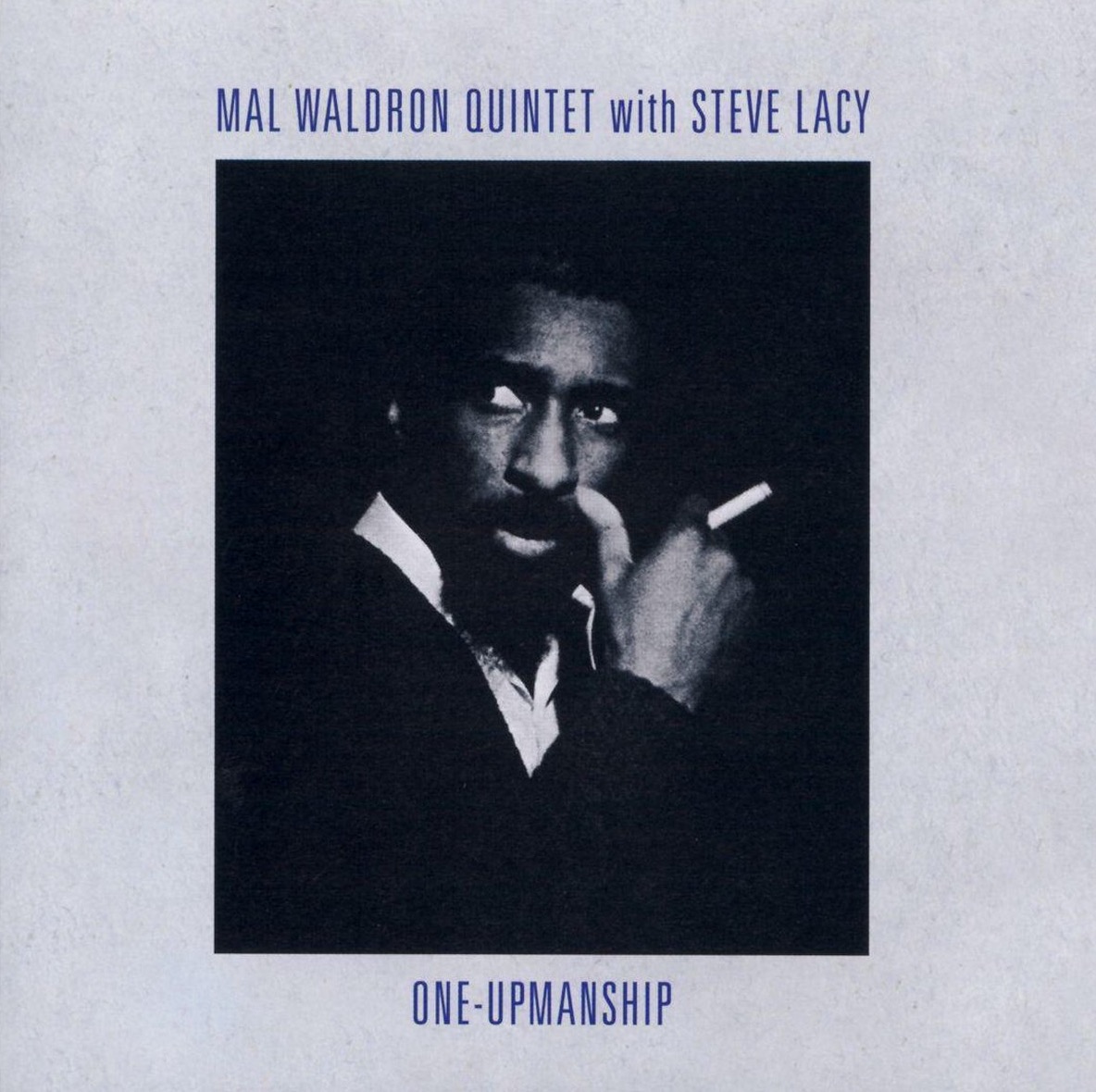
One-Upmanship was the first pre 1963 Mal Waldron album I heard and I fell in love with it immediately. It was the period that, as a listener, I was broadening my horizons trying out some free jazz records. I knew Lacy for it, Mal was still not very well known to me. I was stunned: I never heard a pianist play like this. But also the compositions: I never heard anything like them. They were loud, dark and catchy. Almost funky at places but not the funkiness you wan’t to dance to. I just wanted to sit down and listen. I still regard it as one of my all time favorite jazz albums.

The opening title song sets the tone for the rest of the album: it’s a typical Waldron composition and starts with a catchy theme after which the band slowly fades away and a huge space is created for Lacy’s solo. Lacy is playing a bit more inside than on the America or Victor release but he still surprises with the most strange sounds coming out of his horn then returning back to chord changes or playing with the blues. After his solo the band comes back again with a bridge and then it’s Schoof’s turn to play. And hell he does play a pretty good solo. The sudden break shows the more emotional and calm side of Waldron playing nothing but beautiful notes.

Following up is another Waldron classic, recorded here for the first time. It’s one of Mal’s key compositions, also one of the warm and calm ones. The music has been in my head since I heard it for the first time. The theme hints a bit of classical music but is mostly a very clear description of the Norwegian town of Kristiansund on a cold autumn day. Such atmospheric music. Lacy’s first to solo and as much as he can play beyond the boundaries of jazz he could also play the most beautiful breathtaking notes within those same boundaries. He could play in the highest registers of the instrument and still make it sound beautiful. And there’s also a kind of distance and coldness in his play which funny enough makes it even more beautiful. Mal’s solo is one of simplicity, but he doesn’t play one wrong note. He gently follow’s the changes like the seagulls float in the salty sea air.

The final composition is another Waldron classic: Hurray for Herbie. Not in it’s first appearance on record but it was a studio first time. It starts of with it’s recognizable almost majestic theme. Mal plays a very intense and repetitive solo. As he mentioned himself: “I’ll take two or three notes and really try to milk them dry before I move on to the next two or three notes”. And Mal is a perfect example of all the possible fascinating combinations that are possible with only three or four notes. It makes him the unique pianist he is in jazz, quite the opposite of such a lot of other pianists in those times.

One-Upmanship is one Mal’s better known recordings so it’s not very hard to obtain a copy. If you buy the vinyl version you got the three tracks described above. If you buy the 1998 cd version you get three bonus tracks that were also on the original “Moods” LP. They were from a different session and I will review them with that album. You should get this CD issue especially if you do not own the original Moods LP as 2 of them do not appear on the Moods cd reissue. And those tracks are definitely worth it. One of my first Mal Waldron ‘loves’ and probably one of his best studio albums with one of his strongest groups, One-Upmanship is a must have. Not only for a Mal Waldron fan, but for every jazz aficionado. This is truly essential ’70’s jazz.

Friday, January 22, 2021

(1972) Mal Waldron/Terumasa Hino - Reminicent Suite *****


With: Terumasa Hino (trumpet), Takao Uematsu (tenor saxophone), Mal Waldron (piano), Isao Suzuki (bass), Motohiko Hino (drums), Yuhji Imamura (percussion)
Record date: August 14, 1972

Ah there it is: my one and only FAVORITE Mal Waldron record. And as a huge Waldron fan, that says a lot. If I had the possibility to just save one record from my burning house, it was this one. Not only for its rarity but mostly because i’ts so freakin’ good.

For ‘The Reminicent Suite’ Mal gathered 5 local musicians to perform with him. Some are more known like Terumasa of course but the others are mostly well known in Japan itself but not outside of it. Every single one of them has surprised me with their ability to keep up with Mal. They all sound talented and it’s a pity they never broke trough outside of Japan.

The first suite on side A start with deep droning groove played simultaneously on piano and bass. When the rest of the band starts to play the music gets more intense by the minute. The first soloist is Terumasa Hino who almost play his lungs trough his horn. But every time he almost loses it he grips it back again and rocks it's completely. Next in line is the for me unknown Uematsu who truly surprises me with his sound. He’s daring, building up tension, play both inside and outside but still sound very accessible. He also sounds pretty unique, not like a false copycat trying to imitate an American jazz saxophonist. In the meanwhile Suzuki is all over the place using every single fret of his bass pushing the band to it’s limits. Also shining is Terumasa’s younger brother on drums: Motohiko. A very solid and tight drummer who is constantly responding to what is going on. After the return of the catchy starting theme Terumasa is suddenly alone. He uses electric effects on his trumpet to make the desolate feeling even stronger. The band returns quite soon but this time with soft and gentle notes that resemble a completely different atmosphere. It’s a very sad and dark melody, reminding of Mal’s ‘All Alone’ composition. Tear jerking beautiful. Hino’s solo is more subdued and slow but still pretty loud. Uematsu strikes me a second time as a great saxophone player with a unique sound and his own identity. Again some great soloing by him. One more chorus by the whole band ends side A and leaves me blown away every time I have heard it.

On side B there is another suite: Black Forrest. It starts with some percussion sounds that remind more of the ambient influences in Don Cherry’s music (including the flute playing). It doesn’t take very long before the main theme enters. It’s a modal composition with a funky feel. The first theme has a bop influence in it too, something that was far away on side A. Then a dialogue starts between Hino and the percussionist. Hino’s solo is again of great intensity and very loud: sometimes playing changes but also experimenting with different blowing techniques and unique sounds. On ‘Black Forrest’ Mal also has some more opportunity to stretch out. His sound fits without a problem on the modal backings by the great rhythm section. Still his role is pretty modest on the whole record. Perhaps that is the only downside of it.

What makes this such a great record are the individual talents but also the enormous interplay between them. The huge varieties in tempo, theme’s and atmosphere. But also the way the band really plays on the edge and sometimes over it without losing a fraction of control. The music is so free, yet so structured. You could hear new things in every listen.

This amazing record has been reissued on both cd as on vinyl by BBE recently. If you are a real Mal fan and a music collector it’s worth every penny. There’s also some great news for everybody with a Spotify account: there’s a remastered version on it! One has to search a little as the title is in Japanese but is catalogued under Waldron’s name. A great opportunity to hear this masterpiece. Then after listening to it: write Mosaic a letter they should do a Mal Waldron 'Victor' box!

Sunday, January 10, 2021

(1971) Black Glory ***** & Mal Waldron Plays The Blues: Live at the Domicile ****1/2


With: Mal Waldron (piano), Jimmy Woode (bass), Pierre Favre (drums)
Record date: June 29, 1971


In June 1971, Mal Waldron appeared with his trio at ‘The Domicile’: a famous jazz clubs in Mal’s then hometown Munich, West Germany. It resulted in two fantastic records: ‘Mal Waldron Plays the Blues’ and ‘Black Glory’. Both were recorded that same night so that must have been a hell of concert!

In these years, Mal did work with a (very large) circle of musicians but didn’t had a regular group as he had later with Reggie Workman and Ed Blackwell for example. So on every ’70’s session it’s a surprise with whom he works that time. Here it’s the great Jimmy Woode on bass and the Swiss drummer Pierre Favre. Woode has played with so many musicians, starting with the Duke, Johnny Hodges and Sidney Bechet, then Johnny Griffin and after that so many more like Ted Curson and Art Farmer. His first recording with Mal was with Benny Bailey at the very same Domicile jazz club. He was to appear on two more records by Mal: the live album ‘A Touch of the Blues’ and Mal’s classic ‘One-Upmanship’. A bassist that was mostly in the background, that on these records really is more up in the mix and gets plenty of solo space to stretch out. He reveals himself to be an amazing bassist with enormous potential. He should have been featured more on other records. Drummer Favre was a much in demand drummer within the European jazz and avant-garde scene playing with the likes of Albert Mangelsdorff, Michel Portal and IrĂ©ne Schweizer. But also with Americans like the great Joe McPhee.

Funny to mention: ‘Black Glory’ wasn’t intended to be released in the first place. The plan was to record some of the blues pieces that eventually were on the Japanese Polydor release ‘Mal Waldron Plays the Blues’. The songs on ‘Black Glory’ were to uhm… warm up a little. Enja engineer Horst Weber did a great job recording the complete gig, as ‘Black Glory’ turnt out to be an even stronger record than the other release (though that one is very good also). Black Glory was Mal’s first record for Enja records. The first label he produced multiple albums for part from Victor Japan. Lots of beautiful stuff was to be brought out on the German label: ‘Moods’, ‘One-Upmanship’, ‘Hard Talk’ and even more. It was a fruitful relation.

Black Glory starts of with the Haile Selassie ode: ‘Sieg Haile’. I always wondered if the title wouldn’t be a little controversial in Germany in 1971. After all, the nazi’s were only gone for 26 years. The Bierkeller Putsch there in Munchen was only 48 years ago. Still the title really covers the music: it has a very strong and proud feeling which was probably meant for Selassie but also has that military march feeling. It’s one of Mal’s classic compositions with a fascinating theme. The interaction between Mal and Jimmy Woode is mind blowing. The way Jimmy dances around the chords reminds me of how Scott LaFaro did that with Evans, though this music is completely different. The followup ‘La Gloire Du Noire’ makes a first and last appearance here. It again shows Mal was involved (in his mind at least) with the Black consciousness movement overseas in the United States. ‘The Call’ is of course fascinating to hear in an acoustic version. Horst Weber states he likes the acoustic version better, but for me it’s to close to call. Because of the acoustic sound it does have a more emotional feel. It’s a great song anyway and this version is at least just as good as the electric original on the JAPO album.

For such a classic in someone’s discography, one may state the album is too hard to find. But although long out of print, it is not to difficult to obtain a copy. The whole concert was pretty well recorded. I’ve got the German 1994 release and the Japanese 2006 release. Both are great. This is essential Mal.


With: Mal Waldron (piano), Jimmy Woode (bass), Pierre Favre (drums)
Record date: June 29, 1971 


As this music comes from the very same session as ‘Black Glory’ this review won’t be very long as most of the statements I made there are also speaking for this record. This is the record that was initially meant for release. It’s a big bluesy suite of 5 songs and the tone set on ‘Black Glory’ is very much continued. It’s bluesy, it’s raw, it’s dark and it’s smokey. The space every musician gets is enormous and they all play their butt’s off. Mal said he never really wanted to tell a rhythm section what to play and what not to play. According to them, they had too play what however they wanted to play. That really pays of in live sessions with highly talented guys like Jimmy Woode and Pierre Favre like this. The way Woode imitates motives by Mal and how they interact with each other on “Way in’ for example is just awesome. Don’t think that blues means calm and predictable music here. And though ‘Black Glory’ probably a very tiny bit better, this record still is essential and should not be omitted by any Mal fan.  

The record was initially released in Japan only by Polydor. It was reissued on vinyl in Germany first in 1986 and made it’s first cd appearance in Japan in 1990. I’ve got the German 2001 cd version which doesn’t only sound great but also contains long and informative liner notes including lots of quotes by Mal Waldron. It also was recently reissued in Japan again in a limited budget version on Solid records. Those reissues are mostly pretty cheap and okay sound wise. But do not expect too much from the packaging or liner notes (when you do not speak Japanese of course).

Saturday, January 9, 2021

(1971) Number Nineteen *****


With: Mal Waldron (piano), Dick van der Capellen (bass), Martin van Duynhoven (drums)
Record date: 30 May 1971


Back in Europe Mal did what he did most time of the year when he was there: touring. Mal has recorded a lot in Germany, Belgium, France, Italy and also: the Netherlands. Number Nineteen was the first record he made in Holland and just like on so many of his other records he used local musicians to join him both live as in the studios. For this session he was joined by Dick van der Capellen on bass and Martin van Duynhoven on drums. And just as with all those other relatively unknown musicians: again it’s a pretty big success. Both van der Capellen as van Duynhoven really know how to play. It makes you wonder why such musicians are not better known. Perhaps they peaked in a period that popularity of jazz music was really declining. It leaves much up to imagination of what they could have been if jazz musicians were still the most in demand musicians. Both van der Capellen en van Duynhoven mostly appeared with Dutch musicians with a few exceptions. Especially the drummer’s discography is pretty big.

‘Number Nineteen’ starts of on side A with the title song. A long 22 minute song which is one of the very best from Mal’s entire discography. It’s an intense suite that goes pretty much everywhere: from slow and more emotional passages to highly intense on the beat playing. The music is pretty free yet very structured. Both van der Capellen as van Duynhoven seek their freedom mainly between certain lines which makes the music not too far out but still very exciting. Mal is playing beautiful deep and bluesy repetitive phrases till you’re in an almost hypnotized state of mind. The bassists’ solo really stands out here. He sounds inspired by bassists like Jimmy Garrison and Reggie Workman. Beautiful full and dark rich tones, very much in the atmosphere Mal tries to create here.

On side B there is ‘Trip’ which really do sound like a trip. It’s a song with complex off beat rhythms with a huge role for Martin van Duynhoven who matches up perfectly. Also nice to hear how van der Capellen plays with motives from the main theme in his solo. Watakushi No Sekai starts with a very majestic theme, almost march like. The Eastern feel remains during the whole song but is the strongest during the theme. The following solo by Mal is fantastic with that deep and dark feel, playing harder and intenser as the song progresses. Unbelievable how a pianist who plays only just a few notes still manages to surprise time and time again and keep his solo a fascinating listen all trough. Mal is predictable yet also unpredictable which creates a very nice feeling of tension in his music. And again especially van Duynhoven’s drumming work is insanely good. After the mysterious theme again the record comes to an end. And one wishes there was more to listen to by this group.

‘Number Nineteen’ is pretty hard to find these days. It was only released once by Trio/Freedom records, of course: Japan only. When it pops up at the Discogs or Ebay it is not necessarily over expensive. I bought mine for 30 euros including shipping from Japan. The sound, as with most Japanese releases, is great. Nowadays, British label ‘Black Lion’ has also released this on Spotify and Amazon music. So it’s available in high quality digital files also. Number Nineteen is one of the highlights from Mal Waldron’s career. It’s music that should be played loud only. Highly recommended stuff! Their you go: the first five star album for me in his discography. More will follow :)