Showing posts with label ***. Show all posts

Thursday, May 13, 2021

(1994) Chuck Henderson - Black Issues ***


With: Chuck Henderson (soprano saxophone), Mal Waldron (piano on #5,#6,#7), Raoul Walton (bass), Fred Braceful (drums)
Record date: April, 1994


Now when I first heard the name Chuck Henderson, I thought to myself: I've got to know that guy. Is he some session musician I have totally overlooked in my music collection. He's got a real jazzy name, that's for sure. But he is a pretty obscure figure only recording one sessions as a leader (this one) and appearing on a dozen other albums by musicians that were active on the German jazz scene (including Embryo). For this album he collaborates with other artists from that scene: the great Fred Braceful on drums, who also played on Mal's 'Spanish Bitch' and 'The Call' albums and bassist Raoul Walton who really has played all kinds of music. Mal was already living in Brussels at the time but was of course a well known jazz resident in Munich. He appears only on a few tracks.

So what does this group sound like and what to expect: it's mostly accessible and pretty funky modal jazz. Henderson isn't the most advanced or challenging player but he does a pretty fine job. His composition 'Realising The Difference' has this nice funky feeling with a grooving Raoul Walton on bass. Also the remake of Duke's 'Caravan' is a creative one and makes one laugh with it's repeating bass loop. Mal makes his first appearance on 'Protect the Innocent Pt.2'. The repetitiveness of the music works out pretty well for him and he plays a nice solo part. He mostly just does his thing. The title track is the best one on the disc. It has a more jazzy feeling and Mal's solo is excellent with some good old fashioned backing by Braceful's pushing drums. Henderson's soprano skills sound a little limited here. You want him to 'go out' and explore but he stays mostly on common grounds. On 'Boo Blue' Henderson takes a bluesy duet with Mal. The closing composition is a solo statement by Henderson. It's a nice and thoughtful way to close this record off.

All in all this is an enjoyable effort and an interesting collaboration. But the music isn't very special and fails to make a real lasting impression. Mal's role is limited to a few appearances and a small solo here and there. The cd is not the most easy one to obtain. It's good sound wise, contains some nice photographs of the group plus some thank you words by Henderson. There's also a Japanese inlay in mine which seams to contain some more information. Nice to have but in no way essential.

Tuesday, May 11, 2021

(1989) Jim Pepper - Flying Eagle Live at New Morning, Paris ***


With: Jim Pepper (tenor saxophone & voice), Mal Waldron (piano), Ed Schuller (bass), John Betsch (drums)
Record date: October and November 1989

Most of Mal's records with Jim Pepper were released under Mal's name. All but one: this Tutu disc that is capturing the quartet of those days on three live locations. The music was not only recorded at 'New Morning' in Paris, but also in Innsbruck and at the Tampere Jazz Festival in Finland. I could see why they decided to release it under Pepper's name. It's all a little more of a Pepper recording than a Waldron recording. Yet there is still a lot of Mal to dig down here and this quartet remains a pleasure to listen to.

In style you could mostly expect more of the same music they already recorded together. It's hot and steaming live postbop music. Well structured but still advanced an innovative enough to remain of interest. I like Pepper's style: he has a full and robust tone with a little smooth edge. That's his tone, but his technique and style are nice and unique too. Though all kind of influences are clear he is still pretty clearly identifiable as Jim Pepper.

This recording captures some nice uptempo bop originals like the first two songs. There are also a few of 'Pep's' classics: the traditional Somewhere Over The Rainbow and a suite called Legacy of the Flying Eagle which includes his classic Witchi Tia To. The more uptempo songs are most of interest as they truly capture the energy that this band had. Somewhere Over the Rainbow is nicely played but would have impressed more as a solo outing by Jim. The following Ski Jumping Blues sounds a little cliche here and there. It has this been there, done that feeling. Pepper's vocals are okay but still...

The duo with Mal: Soul Mates is beautiful. A nice view on their duo magic. The chemistry is big and the addition of Schuller and Betsch in the background is an nice adding. With Green Pepper the music suddenly takes a more free approach with highly percussive piano playing by Mal and Pepper's freewheelin' playing over the heavy vamps from the piano. 

There are references to his Native American heritage all over the recording: it's in the artwork, in the title, on the photographs, in the compositions and in his singing and chanting. It's most prominent on the Legacy of the Flying Eagle where Pepper starts chanting and talking to the public. It's interesting to hear a Native American influence on jazz music. Strangely enough not a combination heard a lot yet the music has a lot in common with modal jazz styles. The chanting is a fun twist in the music but on cd it fails to really catch your attention. Must have been a great live performance though. 

From all of the TUTU's this is the one I least like. The records under Mal's name are really more of interest. Still, you can't call this bad music. Like all of the TUTU discs the concert was captured in high fidelity: I love the sound of these discs. You have to be lucky to get one these days but on Discogs they go for pretty reasonable prices.

Saturday, May 8, 2021

(1987) Marty Cook Group - Red, White, Black & Blue ***


With: Marty Cook (trombone), Jim Pepper (tenor & soprano saxophone), Mal Waldron (piano), Ed Schuller (bass), John Betsch (drums)
Record date: November 23 & 24, 1987

Marty Cook is an American trombone player who is a little underrecorded. In the 1970's he appeared mostly in freejazz or avant-garde settings with the likes of Marzette Watts, Jeanne Lee and Gunther Hampel. He moved to Munich in 1979 and that is probably how he met Mal. He formed his 'New York Sound Explosion' band there that also consisted of players like John Betsch and Jim Pepper. The whole quintet playing here knew each other from several occasions and most of them were to play on more records together. Mal recorded with Pepper before that very same year and the excellent rhythm section present here would appear on quite a few albums by Waldron. Mal does not appear on all of the tracks but only on 'Spirit War', 'Love Life', 'Grab Bag' and 'Trapeze'. 

Not a lot of avant-garde or free music to be found here. It's all a pretty big step from the New York Loft sounds of the 1970's where Cook also participated in. The music is structured and mostly in the modern bop tradition. The few outbursts by Pepper's tenor aren't very shocking. Though is group definitely has it's moments it fails to make up to it's potential. Most of the musicians sound a little uninspired. Marty Cook improvises in a very monotone and predictable way without any interesting turns or twists. Pepper sounds like he did not had his day. I miss the powerful almost paranoid like playing from his later recordings with Mal. He mostly draws between the lines perfectly but his capable of more than that. Mal is on 4 tracks but his solo space is very limited. The first place to show off a little is on the 3rd track where he is present. He mostly sounds a little restrained but does give a glimpse of the stuff that to come with the rhytm section. 

So what's there to say in a positive way about the recording? Mosty of the compositions are pretty catchy. Stuff like Spirit War, Mr. DC and Trapeze sound excellent and make a lasting impression. It's a pity that they were only played on this session, for as far as I know. Also none of the guys plays bad. It's clear that every single one of them knows what he is doing and the technical skills and licks are all great. And finally: the rhythm section. Schuller and Betsch together works like magic, hand in glove. They complement each other rhythmically and their playing here definitely lifts the music to a higher level. 

A pretty much ok recording but far from essential. If you want the complete session you'd best get the CD version on Enja or TUTU. Plenty of copies to be found. 

Thursday, April 8, 2021

(1995) Mal Waldron/George Haslam - Two New ***1/2


With: George Haslam (baritone saxophone, tarogato on #2,3 and #8), Mal Waldron (piano)
Record date: April 20, 1995


A second and on record also the last collaboration with the English reed player, George Haslam. Both guys had a cancelled tour date together and decided to make another record for Haslam’s ‘SLAM’ label. The results are engaging though not as great as their first encounter. But there’s enough beauty to dig down here.

Some of the more standard compositions here miss a little inspiration. It’s like they just play it off their sheets without even really trying to do something with it. But there’s some more exciting work as well such as’ One for Steve’ where Haslam plays the Hungarian traditional instrument called a Tarogato (Brotzmann blows that thing to once in a while). It actually sounds pretty much like a soprano saxophone but has a little more exotic feel. The Lacy influence is evident here, like Haslam himself tells in the liner notes. There’s enough chemistry and unexpected twists to keep it exciting.

This album also contains the beautiful Japanese traditional ballad called ‘Sakura’. It’s one of the most beautiful pieces Mal has played in his career and might as well have been his own composition. Is dark, deeply emotional with a slight mysterious atmosphere. Mal remains solo on it.

Like most of the SLAMS, the sound is pretty good, the packaging a little basic. There are some short liners by Haslam himself. It’s just how it looks like. It’s still easy to obtain on the internet for a very decent price. But I’d go for their first release instead. Definitely not bad, but not essential either.


Monday, April 5, 2021

(1994) Judy Niemack/Mal Waldron - Mingus, Mal & Monk ***


With: Judy Niemack (vocals), Mal Waldron (piano)
Record date: July 10, 1994


Well, let’s say Mal really had a thing for ladies that sang. For this record he accompanies the Californian singer Judy Niemack. Thankfully, just like Jeanne Lee, Judy could sing. Though probably not as creative and skilled as Lee, Judy Niemack does have a pleasant feminine voice to listen too. The title says it all: there’s some Monk, some Mingus and some Mal to be played and sang. Just like the Jeanne Lee album it’s mostly filled with ballads.

Most of the record there’s nothing really interesting going on. It’s really some jazz standards played in a very straightforward duet style. Like most of the other vocal albums, there is mostly too little space for Mal to stretch out and play a solo. And when he does, he sounds a little restrained. The version of ‘The Seagulls of Kristiansund’ is quite beautiful with Niemacks sweet voice singing the theme in a very thoughtful matter. Her vocal soloing is also nice with a well sung vibrato that floats over Mal’s chords in the background. Also some solo space here for Mal! The version of ‘Soul Eyes’ is also pretty nice and refreshing to hear in this setting. Again there’s solo space for Mal which he utilizes beautifully in a laidback style. Unfortanely there’s some scat singing here too, for example on Suddenly. I probably never get used to that.

This was released on the French ‘Free Lance’ label. It’s pretty easy to obtain and pick up a copy. Like all Free Lance releases not a lot time was spent on the design and there are no liner notes. All in all a pretty good vocal album that will please most Waldron fans. If you’re a Judy Niemack fan you should get it right away. This is also a pretty positive difference with those vocal records with Tiziana Simona or Femi Bellomo in the ’80’s. Those were terrible. This is ok.

Thursday, April 1, 2021

(1993) Mal Waldron/Michel Marre/Doudou Gouirand - Le Matin D'Un Fauve ***


With: Doudou Gouirand (alto saxophone, sopranino saxophone), Michel Marre (trumpet, bugle, euphonium), Mal Waldron (piano)
Record date: December 10 and 11, 1993


Mal, Doudou and Michel we’re friends for life and played with each other on several occasions. Their studio album ‘Space’ was the first to be put on record. This ‘Le Matin D’un Fauve was the second and also last one. It was recorded live in Tours in a small theater called ‘Petit Faucheux’ where more jazz concerts were recorded in those years. Playing with these Frenchmen is a success in the sense that is showcases another side of Mal. The music is somewhere between free improvisation, noir jazz and classical music. And really everywhere in between. Like Mal is quoted in the liner notes: ‘I change from day to day, minute to minute’. ‘A musician has to change or else he would die’. He certainly applied that to his music. One could immediately identify Mal on a 1966 record or on his last record. His trademarks really always remained the same. But the styles he played in varied enormously. Even in one year. ‘My Dear Family’, ‘Le Matin D’un Fauve’ and ‘Let’s Call This Esteem’; all recorded in the same year but they could not differ more!

This session consists of multiple suites and compositions. Some of them were written by Mal himself, while others were written by Marre or Gouirand. The first two songs have a very strong Waldronesque feeling over them. They are dark, atmospheric and the soft sounds by both Gouirand and Marre we’re well chosen and played. Again ‘Free For C.T.’ is wrongly named. Song 2 is an original that sounds a little like it. But ‘Free for C.T’ is actually track 7 which is credited as Fictions here. The following Marre composition is a bit dull and too repetitive. It lacks originality and does not contain any improvisation. The following improvisation by both horn men also misses the point a little. It get’s a little better when Mal enters with some sweet background playing. All in all the compositions by Gouirand and Marre are among the lesser ones here.

On the compositions by Mal there is more chance for Mal to show off (he’s really in excellent form here) but both Gouirand and Marre fail to make a very lasting impression. Both men do have a warm and very subtle tone but are not very distinctive in their kind. On compositions like ‘Snake Out’ that really stands out too much and the tension for what that composition is known for is almost absent here. Track 7 is Free For C.T. It remains one of Mal’s most beautiful tributes and on this version he plays without any restraints or hesitations: it’s beautiful and straight from the heart. One would wish he would have played it solo.

This music was recorded pretty well and brought out once on the French AA label. There are plenty of copies available on the internet. Interesting music but not essential. Their studio album was a little better.

Sunday, March 28, 2021

(1991) Cristina Mazza/Reggie Workman/Mal Waldron - Where Are You ***


With: Cristina Mazza (alto saxophone), Reggie Workman (bass on #A1, A2), Mal Waldron (piano on #A3, B1, B2, B3)
Record date: probably somewhere in 1991


Another record with an Italian woman. But Cristina Mazza ain’t no singer, she plays alto saxophone. She is mainly active in the Italian scene but she sure ain’t no Candy Dulfer. Mazza plays more avant-garde oriented jazz and is not afraid to make crossovers with a genre like heavy metal, like she did once with John Tchicai on the ‘No Trespassing’ album. Definitely not a boring lady. Also joining is the great Reggie Workman, who fortunately joined Mal on so many occasions. On this record he does not play with Mal. And of course there’s Mal himself who was never afraid to play with new talent or experiment with new styles. But he does not play on all the selections, just a few of them.

The music played here is a little hard to describe. Jazz or jazz structures are pretty far away. In a way it really is free improvisation on some of the selections. But you don’t have to expect loud and angry freejazz. Mazza has a pretty warm and sweet tone. It’s more like Neo-classical music with an avant-garde twist. The less accessible kind. The first two selections are really in that style. It’s a kind of dialogue between Mazza and Workman. And though both play beautiful, after a few minutes it really starts to bore a little. It just misses a groove, a theme and some direction. But they do blend pretty good. It’s not like they are on some different planet. But I just don’t really understand the planet that they are on. On the third track Mal joins for a duet with Mazza. Again it’s mostly free improvisation and Mal mostly follow’s what Mazza is playing. It is again all pretty abstract but he loses some of that abstraction in his own soloing which is beautiful and contains some of the warm energy this record really needed. There’s some blues in there also which is pretty refreshing to hear. This is a composition by Ornette Coleman but it’s pretty hard to get that out of the music.

Side B is a little more structured. The starting duet between Mazza and Waldron is clearly written by Mal, hence the brooding and dark atmosphere in it. But again the total arbitrariness in Mazza’s playing fails to impress. I really miss some idea’s here. The solo piano part by Mal is definitely the best of the whole album. His hot driven almost panicking piano style with it’s constant repeating phrases make a true first statement of feeling and emotion on this record. Of course Lacy’s ‘Blues for Aida’ is also more structured but it really misses a key ingredient…. Lacy himself. Mazza’s playing is ok but could not compare that of the soprano master himself. The closing song is a little unnecessary.

What I mainly miss here is the deep soul that Mal’s records mostly contain. I miss the freedom that he could get out of structured music. I miss some blues All of the musicians play pretty well an Mazza is no exception. But I just miss the statement she wants to make with this kind of music. 

There is no source on the internet nor on the LP itself that says anything about a record date. Only that is was released in 1991 on the pretty obscure Il Posto records. 1990 was the year that Mazza’s career started of so it was probably recorded in that year or in 1991. For some weird reason Il Posto released most of it’s stuff on LP and did not issue it on cd. That was pretty unusual in those years. The sound quality is not so great for something that was recorded in those years. It’s still pretty easy to obtain on the internet. One has to pay around 30 euros at least for it. If you ask me, there are better ways to spend them on another Mal record.


Friday, March 26, 2021

(1991) Smoke Gets In Your Eyes ***


With: Mal Waldron (piano), Paulo Carduso (bass 1-4, 6-8), Stafford James (bass #5), John Betsch (drums 1-4, 6-8), Eddie Moore (drums #5), Barney Wilen (tenor saxophone #5), Beat Kiffsteiner (flute #6)

Short review for this one as it’s mostly a combination of two other record. This Alfa Jazz cd is a compilation with some tracks taken from ‘No More Tears for Lady Day’ (#3, 4, 8), ‘Spring in Prague’ (#1, 7) and ‘Movie Theme’s From France’ (#5). That means it contains 2 new tracks: Lonely One and A Dream of Love. The first is a pretty straightforward almost dull short jazz standard. The second is an interpretation of a Liszt composition that isn’t really a success. Beat Kiffsteiner’s flute gives it a silly sound. So yes, of course there are some great songs on this disc but you should probably want the original releases that were all three very good. Buy this one only if you really want to complete you’re Mal collection like I did. Unnecessary release.

Thursday, March 18, 2021

(1989) Tiziana Ghiglioni/Enrico Rava/Mal Waldron - I'll Be Around ***


With: Tiziana Ghiglioni (vocals), Enrico Rava (trumpet), Mal Waldron (piano)
Record date: July 25 and August 1, 1989


Mal and Italian female singers…. there was really something between them. This was not his first, nor would it be his last recording with one. This time it’s Tiziana who sings. Fortunately not Tiziana Simona but Tiziana Ghiglioni who really is better singer in my humble opinion. Italian trumpeter Enrico Rava also joins in with his warm and lyrical trumpet playing.

Composition wise there aren’t a lot of surprises. The repertoire consists out of standards only, most of them are affiliated with Billie Holiday in some way. Tiziana has a warm and very feminine voice. She has a soft voice and is pretty accesible in that way. Mal accompanies her in the way he can accompany a singer: thoughtful chords an backings in support of the singer. Rava interacts with both Mal as with Tiziana, playing sweet lines in the background an playing solid solo’s. In no place this is a shocking album, it’s all very straightahead and a bit predictable. My main problem with these kind of albums is that it seems to kill the creativity of the other band members. Both Rava and Waldron really just play nice but don’t have an opportunity to shine. They do have some nice moments together on ‘You Don’t Know What Love is’. Rava’s warm and lyrical tone blends very well with Mal’s moody backings. And Mal’s solo is beautiful here. Part from that, it’s a bit dull at times. That probably also has something to do with the safe compositional choices. It also misses a bit of emotional depth. Where Billie could really touch or thrill me, Ghiglioni can not.

But… she can definitely sing and has a pleasant voice. I would enjoy her presence if she was singing in a local restaurant or something. This one is in the 11cd Soul Note box but copies of the issue itself are also still widely avaible. Soul Note fails to mention that not every song is in trio form. There are also duo's and a solo.

 Definitely one of the better vocal albums from the ’80’s. Not bad but just not really my cup of tea.

Wednesday, March 10, 2021

(1988) Evidence ***


With: Mal Waldron (piano solo)
Record date: March 14, 1988


The recording year 1988 starts with a solo album by Mal. Evidence was recorded in March for the Canadian label Dark Light Music Ltd. in Toronto. Mal plays mostly standards here, quite a few that he has played before in all kinds of settings. Of course there’s some Monk too. This means there are not a lot of suprises. When Mal plays standards he always play them very well, but mostly in a very straightforward way. This one is not an exception. Probably the most interesting are the two Rhapsodic Interludes that contain some more improvisation and inspired playing by Mal. Here he seeks more freedom in his playing and there’s more thematic variety.

One could never call the music on these kind of albums bad but to say it’s very interesting: it just is not. My short review says enough. Only one version of this album was released in 1991. They go for around 10 euros but I had to wait for years before one popped up. For completists only.


Tuesday, March 9, 2021

(1987) Mal Waldron/René Bottlang - The Lausanne Concert ***


With: René Bottlang (piano), Mal Waldron (piano)
Record date: December 20, 1987


The last 1987 recording by Mal was a live recording in Lausanne, Switzerland. Another piano duet, but this one was to be his last on record. This time it’s Swiss piano player René Bottlang. Bottlang has recorded mostly as a leader himself but also made an appearance next to Charlie Haden. His style is much influenced by Keith Jarrett. It definitely has it’s moments but it’s a little too smooth here and there for me. But Bottlang is also a very different pianist than Yamashita or Tchangodei which makes it another interesting listening experience. Mal always picks up a little from what the other is doing in a duet which means you hear another side of him.

The album consists of two long suites. Some parts are pretty abstract, others more melodic with moments of absolute beauty. Again, this really isn’t a battle or competition. Just like the other piano duets it’s mainly about feeling what the other is playing and try to interact with it or support it. Mal’s playing on his own Soliloquy is such impressive with it’s deep emotional load and feeling. Sometimes he just hits all the right notes, and not a single wrong one. The sudden merge into Evidence reflects his sense of humor. It’s creative music with enough variety in playing but it fails to keep your attention for the full set. The live experience must have been pretty impressive but on cd it all just goes on and on.

Not bad at all but just not that interesting. This music is easy to obtain both in it’s original release as the reissue that I have myself.

Friday, February 19, 2021

(1985) And Alone ***


With: Mal Waldron (piano solo)
Record date: September 1-2, 1985


Mal’s stay in Japan in 1985 was a pretty productive one. The first record he made was a solo effort for Sony Japan. It’s his first solo record in a studio since the 1972 Paula album: ‘On Steinway’. That album contained four very interesting originals, this one consists mostly of standards and 2 Mal classics that seem to be obligated to play for Mal in Japan: All Alone and Left Alone. The result is a nice but pretty straightforward album. It’s a lovely album do some work at home to, or read a book in front of the fireplace. Not a record that strikes with surprise after surprise.

When Mal plays standards solo he mostly really play them and improvise around the theme. That means no explorations outside of the chord schemes or anything. He plays them in a very classic way with thoughtful ornamentations around some of the notes. With one exception, this album is also a ballad only album. So just be prepared to listen to some nice piano playing.

This album was reissued quite recently in 2015 and is still in print. The original is not hard to find either. If you’re looking for a very straightforward and relaxing record this is one for you. But Mal made much more exciting work solo, both live as in the studio.

Monday, February 1, 2021

(1980) Solo Piano: Live in Vancouver 1980 ***


With: Mal Waldron (piano solo)
Record date: somewhere in 1980


This is the most recent release of ‘new’ music by Mal Waldron. A solo outing far from his home in Munich, at the west coast of Canada in Vancouver. Mal probably made a North American tour that year. It was from this time he would visit the USA more often than he did before.

So what to think about this record? It is ok. The opening improvisation really sounds like Mal improvising around a spontaneously made up melody and it works out well. It starts more classical oriented then slowly merging into a more bluesy sound. The following Waltz and Shout is indeed waltzing around with lots of repetitive patterns in his playing. A happy melody but nothing really special. The following untitled blues is a pretty long suite where all kinds of themes are passing by. They got a deep bluesy feel in common. It’s pretty relaxing music and Mal takes his time to improvise and tell his stories. The theme of ‘Thoughtful’ passes by at around 9 minutes, there’s a slight hint of It Aint Necissarly So. It’s the first time by the way I can hear him mumble while playing. But fortunately not as loud as for example Keith Jarrett. Oscar Peterson, Bud Powell and Abdullah Ibrahim also do that but it never bothers me. One could here the suite merging into Thelonious Monk’s Ephistrophy and it’s a real bummer it’s cut off. Monk was a prominent influence on Waldron’s playing but he did not play a single tune by him between 1966 and 1980. Of course later he would, with Lacy most prominently. But it would have been interesting to hear his solo treatment in 1980.

The closing three standards including his own Fire Waltz are all ok but nothing special there.
Of course this is not a stone cold classic, but it’s a nice way of hearing Mal playing solo in these years when a new change of style was yet to come. He would leave the more free path he had chosen and went back to standards and blues for a while. With a few exceptions of course, it depended on who he played with. With Dyani and Lacy for example he still managed to play outside a bit, but there is definitely a pattern visible of gripping back on more traditional jazz and improvisation.

This is a download only. The label ‘Condition West’ asks 4.50 euros for a download which is more than reasonable. They warn for bad recording quality and indeed it’s not great but it is far from unlistenable. There’s a slight hiss in the background and the piano does not sound very well. Also, some of the songs are cut off which is the biggest downside of it. Part from that it’s pretty much ok. Not essential but for less than 5 euros, you could give it a try.

Friday, January 29, 2021

(1979) Mingus Lives ***


With: Mal Waldron (piano solo)
Record date: February 29, 1979


In 1979 Mal was on tour with German drummer Klaus Weiss. Having released two masterpieces in the previous years he wasn’t really active in 1979 in the studios. The only record he really made was this solo live record, which was recorded in a small jazz club in Spa, Belgium. He plays originals only of which two are pretty well known: Snake Out and Here, There and Anywhere (which is mistitled and should have been Here, There and Everywhere). 

This really isn't one of his most recommendable solo works to be honest. Though there are some pretty good and interesting parts, most of this solo effort is a bit forgettable. The opening title tune misses a bit of a direction but it misses mostly that typical Mal feeling. It’s a nice effort but it’s just nothing special. One would have expected more from Mal honoring the great bassist. The version of ‘Snake Out’ is the most interesting on this album. Mal takes his time to fully stretch out on it and plays like a maniac almost destroying the pianos keys. Much energy for just a solo performance. As he speeds up he never gets out of time or off beat anywhere. A prime example of his percussive playing. The other interesting part comes with ‘Here, There and Everywhere’ which again is sped up a little and full of passion.

What is really bothering is that the piano is out of tune. In some parts it’s acceptable but in other parts it really ruins Mal’s playing. Keith Jarrett probably would have become very angry and left the concert venue. Fortunately Mal is a more modest person and did play the damn thing but one can’t make right what sounds wrong of course.

‘Mingus Lives’ was never released on cd, probably because of what I am writing in my review: it’s not a bad record at all but there are far more interesting solo sessions by Mal, both live as in the studio. It's widely available for a low price on the web. Nice to have but not essential.

(Correction: Mingus Lives now has a first time cd release! Reissue on Solid records)

Thursday, January 14, 2021

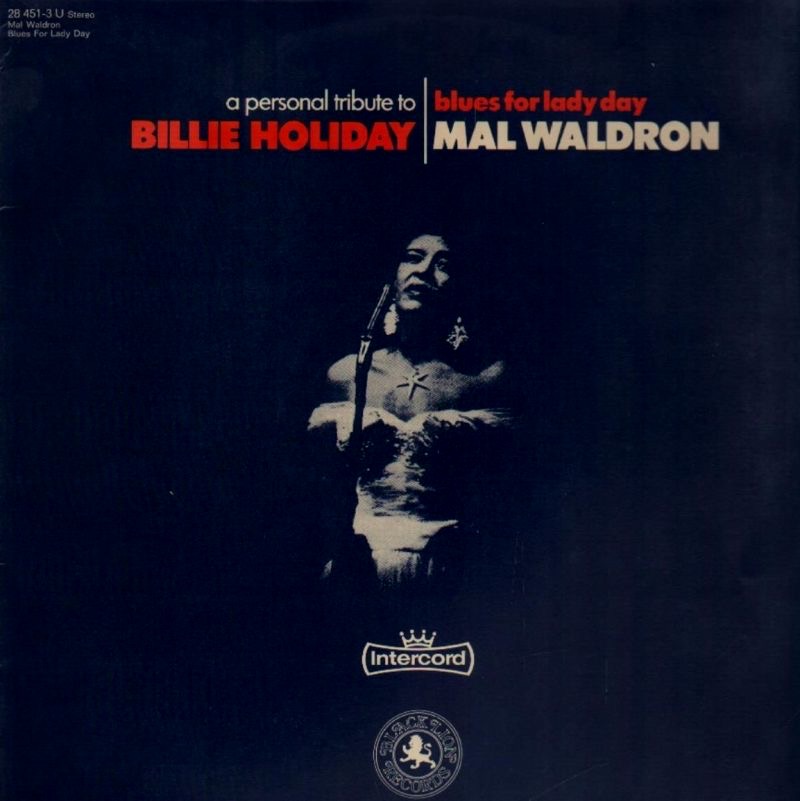
(1972) Blues for Lady Day ***


With: Mal Waldron (piano)
Record date: February 5, 1972


1972 would become another very productive year for Mal, delivering multiple solo works and a few records with great groups. He still spend most of his time in Europe or in Japan. His first record of that year was recorded in Baarn, the Netherlands. It’s one of his multiple tributes to Lady Day who he accompanied till her death. When Billie died, Mal was devastated and he always kept her in a special place in his heart. He pad tribute with multiple records recorded in her honor. Not just songs, but full albums! ‘Blues for Lady Day’ was his second, after the previous record with Kimiko Kasai.

On ‘Blues for Lady Day’ he plays 9 jazz standards that are all more or less affiliated with Billie Holiday. Mal Waldron solo could be very, very interesting but also in some cases: a bit dull. This record is rated pretty high on websites like RYM and Allmusic but I personally do not really hear what all the fuzz is about. Mal plays 9 standards in a very decent way. Decent… no more, no less. There’s not that familiar tension in his playing, but it also lacks some emotional feel, which is weird because some of the songs should really have that feeling. It’s a nice listen and you wouldn’t piss anyone off playing it when you have visitors for a coffee but Mal made such better records. His soloing also sounds a bit uninspired like he just didn’t have his day.

Highlight of the album is probably ‘You Don’t Know What Love Is’. Now, the original by Billie could almost make me cry, and Mal captures the right atmosphere here. It has that beautiful sadness over it. His handling of 'Strange Fruit' is also beautiful with the dark and low tones from his left hand. 

‘Blues for Lady Day’ was originally released on Black Lion, which means it is still widely available on second hand vinyl for a low price. You have a choice from 8 different kind of versions, also on labels affiliated with Black Lion like Arista, Freedom and Trio. The 1993 cd version, with different artwork, has a nice bonus for vinyl haters: it contains the whole session of ‘A Little Bit of Miles’ which was recorded after this one that same year. That one is pretty difficult to obtain on cd. Also, the music is available in high resolution files and trough multiple streaming sources. Give it a spin and see how you like it. To me, this is not an essential record.

Thursday, January 7, 2021

(1971) Mal: Live 4 to 1 ***


With: Koshuke Mine (alto saxophone on track A1 and A2), Mal Waldron (piano), Masabumi Kikuchi (piano on C1 and C2), Isao Suzuki (bass A1 to B2), Yoshiyuki Nakamura (drums A1 to B2)
Record date: March 2 and 3, 1971

This album captures Mal live in 4 different settings: the A side contains a quartet, the B side a trio, side C is a piano duet and side D is Mal solo on piano. Hence the title 4 to 1. The music was also released as ‘Left Alone- Live 1’ on Fontana (side A and B) and ‘All Alone - Live 2’, also on Fontana (side C and D). 

Let’s start with the quartet on side A. Saxophonist Koshuke Mine clearly plays at the top of his abilities but those abilities do not reach very far. On ‘Left Alone’ he’s okay, playing a fine and balanced solo. His tone lacks character a bit. On ‘Straight No Chaser’ the lack of technique also shows up. He plays with pretty much the same ideas all over again and fails to impress or sound original. He reminds me a bit of myself when I was playing alto saxophone, focussing heavily on blues scales. Bassist Isao Suzuki sounds more promising. He swings and gives Mal some great support. Yet there is not much space for him nor the drummer to stretch out. Mal plays an okay but not very inspiring solo.

Side B is more interesting. The trio starts with a very strong perfomance of the Mal original ‘Right On’ which was first to be heard on Mal’s solo record ‘The Opening’ from the previous year. After playing fascinating theme the band goes into hard swinging postbop territory. Both Suzuki and Nakamura play their butt of and show they know how to play. Suzuki’s solo in inspiring, daring to leave traditional bop scales and showing he knows what was going on in jazz land in those years. And the same is to be said for the drummer. Surprisingly good! ‘Thoughts’ is from that year’s record ‘The Call’. In the acoustic version it’s just as a fascinating composition as on ‘The Call’ where it’s played on an electric piano. The version here has of course a more jazzy than fusion feel. Again the chemistry between the band members is clearly present and their interaction is lovely, slowly building up to a climax, then slowly fading away.

Side C is a piano duo with Japanese piano player Masabumi Kikuchi. Mal is in the left channel, Kikuchi in the right. The piano duo is a fascinating form and really demands from both players that they listen closely to each other. When the chemistry is there, it could turn into a fascination soundscape. The opener ‘Little Abi’ is a beautiful and subtle ballad where both pianist do exactly what’s needed: they listen to each other, not missing a single piece of what the other is doing. This is beautiful, classic and stunning Mal. One of those ballads that would be on a ‘Most Beautiful Songs By’ compilation. Unfortunately there’s no such compilation but I would love to make one! The following ‘Blood and Guts’ is less sweet and subtle of course. Interesting to hear that Kikuchi and Waldron have split the pieces they play. Hearing the theme it sometimes sounds like 1 pianist. After it Kikuchi starts with his solo which is pretty good, copying ideas by Waldron but staying close enough to his own. His mumbling makes one think Keith Jarrett is also present in the building….

Closing up are the solo sessions on side D. Mal always plays nice, but when he goes solo he plays his own originals best. He sticks to standards here (part from ‘All Alone’) and they just sound ok, no more no less. He sounds a bit uninspired, as he does mostly when he plays standards solo. The closing ‘All Alone’ is beautifully chosen to close the concert. This remains one of his most beautiful compositions. It’s mostly written down music, but it’s beautiful in any version he played.

All in all, this record is bit of mixed bag. Some of the sessions are ok, some are good but none are truly essential. When you want to buy this you’ve got plenty of choice. I would not recommend the separate Fontana’s as they really not sound very well. I don’t know about the separate Philips releases of Left Alone and All Alone. I do know that both the Phillips Mal Live 4 To 1 from 1971 and 1979 sound very good and are available for around 40 euros which is not bad for a double LP gatefold. Liners are of course in Japanese. I would not recommend the expensive and rare cd version as it misses two songs: Straight no Chaser and Willow Weep for Me. They should definitely have chosen for a double CD version and include all the tracks. I hate half a sessions.

Wednesday, January 6, 2021

(1971) Kimiko Kasai & Mal Waldron - One for Lady ***


With: Kimiko Kasai (vocals), Mal Waldron (piano), Yoshio Suzuki (bass), Hiroshi Murakami (drums)
Record date: February 13, 1971


Everybody knows Mal of at least one thing: as Lady Day’s last pianist, staying with her until her death in 1959. When she died, Mal was devastated. He always saw her as a sort of a big sister. After her death he paid tribute to her in many ways, with multiple compositions written for her and even complete albums. Mal has also collaborated with lots of singers since those days: Abbey Lincoln, Jeanne Lee, Kim Parker, Sumiko Yoseyama, Kimiko Kasai etc. etc. etc. His dark, bluesy and minimalistic sound fits perfectly with a female vocalist. This Lady Day tribute was his first since his breakdown in 1963. He is backed by a fine Japanese band and accompanies Japanese singer Kimiko Kasai on 8 songs that are all affiliated with Billie Holiday.

I really do not like vocal jazz. I’ll explain further here below. On the record: Kasai could definitely sing. She has a sweet and tender voice and doesn’t show off too much. She also speaks English fluently and that helps a lot in listening comfort. The eight standards were chosen with care and are honoring Billie Holiday in a way she deserves. The songs are all pretty slow ballads, so the atmosphere is warm and calm. There’s not a lot to say about the band as they all play well but do not really solo. Mal plays fine details in the background and has one chance to really play at bit on ‘Yesterdays’. All in all he plays a pretty modest role on this record. Yet he is recognizable immediately.

About me disliking vocal jazz: the only two singers in my collection, part from all the collaborations  with Mal, are Billie Holiday and Ella Fitzgerald. Billie has a special place in my heart, there’s nothing like her. I love all the stuff she has made, from the Columbia ’30’s records till her final records with her broken voice in 1959. Her voice is just pure feeling and emotion. Ella is just a very good and swinging singer with an astonishing technique and ditto personality. And yes Sarah Vaughan, Dinah Washington and Abbey Lincoln they all could sing, but I just don’t like listening to it…. That means the vocal albums with Mal are never rated very high by me. Personal taste definitely plays a role In that. So if you do like vocals, keep that in mind and judge for yourself.

This is a fine jazz album which would definitely be appreciated by vocal jazz lovers. Kimiko does have talent! She’s the best singer I know from Japan at least. The album is widely available on vinyl for low prices but never was reissued on CD as with most of the Victor recordings by Mal. Someone really should do something with that catalogue.


Thursday, December 31, 2020

(1970) Tokyo Reverie ***


With: Mal Waldron (piano)
Recorded on: February 7, 1970


During that first trip to Japan, Mal also recorded his first solo piano effort since the ‘All Alone’ album on GTA. Quite contrary to that album, and to many of his excellent solo outings after, ‘Tokyo Reverie’ isn’t very interesting. The quality in most of his solo music is the tension, climaxes and emotional feeling all through the music. ‘Tokyo Reverie’ lacks those ingredients. Every song was inspired by his stay in Japan. One would think it would result in more inspired music but that is not the case unfortunately. Most of the songs don’t really get anywhere. Absolute highlight is the beautiful ‘Sayonara’ which is kind of based on eastern melodies. And when I would compose a ‘best of’, that song would be selected by me. The album does contain a classic Mal composition also: Blood and Guts in it’s second appearance. But the live version on the Futura live album from only 3 months later is definitely more interesting.

Mal never plays bad but this is one you could skip without missing something big. Still, if you are a big Mal fan, do not hesitate. The album was released on vinyl only, and only in 1970 as an original and as a promo. It’s not very rare and mostly goes for around 30 euros. The gatefold is beautiful and the sound quality is excellent.

Sunday, December 27, 2020

(1967) Sweet Love, Bitter ***


With: Dave Burns (trumpet), George Coleman (alto saxophone), Charles Davis (tenor saxophone), Mal Waldron (piano), George Duvivier (bass), Alfred Dreares (drums)
Record date: March 23, 1967 (officially, but probably in 1965)

In 1967, Mal Waldron went into the studio to make his only recording for the famous Impulse! label. It’s a score for the movie “Sweet Love, Bitter”. A movie about a jazz musician that gets involved with drugs and booze, that eventually causes his downfall. When Herb Danska (the filmmaker) was thinking about who would be able to make a fitting soundtrack, he immediately thought of Mal Waldron. He was looking for a soundtrack that was having that dark and emotional feel, and what better choice would be Mal Waldron, who already had composed music for films before.

And that’s really what this is: a score for a movie. Nothing more, nothing less. That means the music is secondary to the movie. And that is something you can hear. Mal plays with a pretty great band here, but most of the music is composition only and there are not a lot of possibilites for any of the musicians to stretch out. The sparse solo’s that are played are ok, but the songs are very short, especially for jazz song. George Coleman is making an appearance on alto, while better know for his tenor playing. He has a couple of chances to solo, and he sounds pretty good. His huge vibrato make me think a bit of the classic alto players like Johnny Hodges and Benny Carter. Charles Davis is playing the tenor. He mostly play that modest background role, and here it’s not really different. Mal himself stays mostly in the background. The best song of the record is the opener ‘Lament for a Loser’: a moody Waldron original loosely based on his classic ‘Left Alone’. Coleman is in fine form here.

Impulse! never reissued the music on cd in Europe or the USA. Probably for the reasons I mentioned above. This is fine music but not more than that and not a very good chance to hear Mal’s developments. There are two versions on cd released in Japan only. Thank god the Japanese loved Mal so much: thanks to that there are a lot of reissues available from that country. Mostly in beautiful quality. I’ve got the 1972 Impulse! gatefold reissue on vinyl myself. Thin vinyl but fine quality.

It’s quite unlikely this music was recorded in 1967 as an attentive Organissimo board member noticed. The movie debuted in January 1967 so its a bit unlikely the music was recorded 2 months later. Also in the book ‘Living the Jazz Life: Conversations with 40 Jazz Musicans’ Mal himself says he returned to the US in 1965 to record the score.