Saturday, May 8, 2021
(1987) Marty Cook Group - Red, White, Black & Blue ***
Thursday, May 6, 2021
(1979) Klaus Weiss Quintet - On Tour ****
Tuesday, May 4, 2021
(1978) Klaus Weiss Quintet - Child's Prayer ****
Mal has worked with German drummer Klaus Weiss on multiple occasions. He was in his touring band. There are two official records of those encounters: this studio album and a live record from 1979 called 'On Tour'. The German drummer was a pretty well known figure within the German jazz scene and made lots of records for different recording companies. In 1975 he got Billy Harper and Cecil Bridgewater playing on his excellent 'The Git Go' album where he played Mal's composition even before Mal recorded it himself. He is an excellent drummer with a nice feel for more adventurous music. Never into avant-garde territory but the music is definitely more than ordinary contemporary jazz music. Most of the other German band members played mostly within their national jazz scéne except for bassist Knauer who also played regularly next to Chet Baker. Mal himself here was at an artistic peak releasing albums for Enja like One-Upmanship and Moods and running his own sextet with Steve Lacy, Terumasa Hino, Hermann Breuer, Jimmy Woode and Makaya Nthsoko.
So what kind of music is to be expected on this record: restless and adventurous postbop! The first three compositions were all written in honor of John Coltrane by Mal Waldron. And they have his (Mal's) trademarks all over them. The first composition starts more in a Trane like atmosphere but evolves slowely into a song that reminds of Mal's Git-Go composition. Schwaller's role is pretty limited here only playing the chorus. Mal is in the spotlights and he solo's like he did in those days: hunted and full of tension with a heavy left hand approach. Same goes for his excellent 'Shades of Coltrane' composition where he only uses a couple of phrases to create a hypnotic atmosphere with wide spaces for Weiss en Knauer to stretch out on. Schwaller's solo here is excellent with a creative and original approach. He definitely has a sound of its own and it sounds mature an masculine.
Side B consists of three compositions that were not written by Mal but by the other band members. That means the music lose some of it's originality and quirky sound. It goes back into more known and mainstream territory. That means the music is still good, the band still swings but it all sounds a little less exciting than on Side A. Big exception is 'Drone' which was written by Weiss himself. It's really a showcase of the whole band's qualities with excellent solo's by Schwaller, Moll and Weiss himself.
The LP was released by Musician's Record Co. and was never reissued. It's so unfortunate that this kind of music will be forgotten for nobody thinks of reissuing it. Truly a missed opportunity for the musicians talents are evident and the music is great. Fortunately copies of the original release are widely avaible. If you ever see a copy anywhere for a low price, do not hesitate!
Saturday, May 1, 2021
(1968) Benny Bailey Sextet - Soul Eyes: Jazz Live at the Domicile ****
Record date: January 11, 1968
Paris is always said to be the creative centre of American musicians that resided in Europe. Of course that is true but Munich was also a pretty good place to be if you wanted to see some of the American top jazz musicians. Both Waldron and Bailey lived there, among others. And the Domicile was the place where they played so many nights in different settings. A bit like the ‘Village Vanguard’ of the Bavarian capital. Some very, very good music was recorded here: concerts by Charles Tolliver, Pepper Adams, Mal’s own Black Glory of course and this very record. Mal is not the only one that puts a smile on my face here. I have a real soft spot for both Jimmy Woode and Nathan Davis. Combining those names must lead to some exciting music.
Benny Bailey was a pretty busy man during his lifetime. His recording career started mostly in the bands of Dizzy Gillespie and Lionel Hampton. He really remained a bopper for the rest of his life. This record is in that style: nice uptempo hard swinging hardbop. But with such talented musicians that always leads to advanced music anyway. This is one very exciting jam session.
The first composition ‘Prompt’ is really an example of some of that fine and excellent bop. Most impressive are both the solo’s of Davis and Waldron. Davis is on tenor here and boy I just love that man’s sound. There’s a little Prez, a little Dexter Gordon but mostly a whole lot of Nathan Davis there. A powerful and advanced player who shines on every reed instrument he plays. His sound is warm, bluesy and just feels like a blanket on a cold day. His flute playing on Soul Eyes is also excellent but I would have loved to hear him on soprano here. With Davis sticking to flute the whole composition is pushed into more traditional territories while this group could have made something more interesting out of it.
The big excitement comes with Jimmy Woode’s composition: Ruts, Grooves. Graves and Dimensions. This is music that expands a little further than bop and this is where every musician is at it’s best. Bailey leaves his comfort zone here and plays a pretty advanced solo. He leaves the more traditional jazz patterns behind. Mal is lovely here too and one can hear he is truly developing his definitive sound here. He fares very well by this great modal composition by the hands of Jimmy Woode. He’s starting to sound more and more like the Mal we know with his hard hitting left hand, repetitive but swinging playing and overall very bluesy sound. Nathan is on tenor again and of course he was the very musician here that was so open to ‘the new thing’. His playing is influenced by it in a very positive way for he does not lose his own identity for a second. 12 minutes of very exciting music.
The final composition ‘Mid-Evil Dance’ was written by Nathan Davis. This was one group I would love to have seen, Davis’ robust tenor sounds fit so well with Mal’s deep chords and Woode’s free yet swinging bass playing. He could fit into a free playing group, but still swings as hard as Coleman Hawkins. What a sound! Bailey really loses himself here screaming trough his horn and Mal: he just swings like a mad man seeking constant interaction with Woode.
This is some very exciting music from the ’60’s European live jazz scene. The people that were in the Domicile that night were very lucky. It’s one of the more difficult to find MPS records. Well it’s not very difficult to find a copy, it’s mostly just that the copies are pretty expensive. Ive got the 1998 Japanese cd version myself. Can’t say I really like the sound, but that must be the recording itself for most Japanese MPS records mostly sound excellent. Highly recommended for Waldron fans, Davis fans and also Bailey fans. And a special shout out to Jimmy Woody: he was one hell of a bassist!
Tuesday, March 30, 2021
(1993) My Dear Family ****
With: Grover Washington Jr. (soprano saxophone on #1, 2 and 5), Eddie Henderson (trumpet, flugelhorn on #1,3,4 6-8), Mal Waldron (piano), Reggie Workman (bass), Pheeroan Aklaff (drums)
Record date: September 23 & 24, 1993
Like so many other jazz musicians, as the aging progressed, the sound of Mal became milder and milder. Especially the Alfa records are very accessible an mostly very much subdued. But with Mal it did not mean he was becoming a boring pianist that was sticking to standards or something like that. The innovative part of his playing was still there but more between the boundaries of straight ahead jazz. But as Mal stated himself: you always have to look forwards, because if you keep looking backwards you might stumble. This last session for Alfa Jazz Japan, recorded in the States is far from boring. But it is a very gentle Mal one hears here. Lots of ballads with only a few exceptions.
Mal was becoming so mild he even decided to work with…. Grover Washington Jr. Respecting every musician in his own way, I am not going to make offensive statements about the guy. But I really, really dislike his sound that reminds me mostly of ahum….. Kenny G. There… I said it. Smooth jazz is for me the anti jazz that freejazz was to so many conservative listeners back in the day (and also still nowadays). I just don’t like it at all. So seeing Washington’s name on the back cover did not make my heart beat faster as one might understand. But I have to say: he’s ok here.
In fact on ‘Footprints’ he actually gets a little triggered by the rest of the band to leave his safe grounds. And then it’s immediately hearable the guy could really play and has an excellent technique. Yes even some soul probably. The rest of the band hardly need an introduction. After Woody Shaw, Henderson is another trumpet giant from the States who experimented with fusion, free forms and of course mostly hard swinging postbop. A guy with fabulous technique and timing. I probably have already said enough about Workman on my blog. That leaves Pheeroan Aklaff who I personally really see as one of the top drummers of jazz today. He mostly made fame in Wadada Leo Smith’s Golden Quartet/Quintet but played with so many legends. On this record he is mostly in the background unfortunately and I really pity the fact that he did not play on more occasions with Mal. Like Andrew Cyrille or Ed Blackwell, he would have been a perfect fit. Would love to hear him with the more fiery pieces by Mal like Snake Out or Hooray for Herbie.
Mal’s classic Left Alone puts Washington back in his safe zone which is really unfortunate. His overly smooth sound with it’s predictable licks really not sound sincere. And that really spoils this oh so beautiful ballad and turns it into some honey sweet song that lacks the feeling like on the version with Archie Shepp for example. ‘Sassy’ is a laidback waltz written by Mal with some nice muted trumpet by Henderson. His playing is even better (and more beautiful) on the impressive Japanese folk song ‘Sakura Sakura’. With it’s dark and very moody atmosphere it could easily have been written by Mal himself. But it mostly showcases how Mal’s style really blend with eastern oriented music. That has always been an influence on his own work. When he’s soloing on it, conversing with Workman, constantly playing those dark low chords, that is him on his best.
The rest of the album consists mostly of slow ballads that are all equally beautiful. Again Washington’s tone on the only jazz standard here is a bit too smooth for my taste. Big exception in laid backness is Miles Davis’ funky Jean Pierre that goes surprisingly well in this setting with an all acoustic band. The version Mal recorded later on his album with David Murray was even more exciting. Mal met Miles Davis only once and Miles wasn't very nice to Mal. Miles told Mal: 'you know, you remind me of my brother' on which Mal replied 'oh yeah Miles?'. 'Yeah', Miles said. 'And he's a faggot and I hate him'. Not very friendly but Mal loved him anyway, even after that encounter.
Like most of the Alfa Jazz releases, most of the music here is very accessible. This is not the wild, funky and hard grooving Mal with some loud out there playing or something like that. It is a very pleasant record to listen to with some very, very good musicians and it does contain some beautiful tracks. Music does not always have to be fast or loud. The Alfa cd is a little bit rare. Most sellers dare to ask ridiculous prices for it like they always do with OOP Japanese releases. I do have it and is sounds great but of course as always I am not able to read any liner notes. So maybe the American Evidence release, with different cover art, is the better choice? One could pick up that one easily on Ebay or Discogs. This is Mal Waldron for when you come home after a very busy day. Or when you just want to relax.
Wednesday, March 17, 2021
(1989) Where Are You? ***1/2
Record date: June 10, 1989
Where Are You? Was recorded on the very same day as Crowd Scene with the same personnel but has a very different sound. Where ‘Crowd Scene’ is full of tension and bursts of energy, ‘Where Are You’ represents the softer side of the group. That doesn’t mean it consists of ballads or slow music but it just has a different more laidback energy.
The album start with a solo interpretation of ‘Where Are You’ by Mal himself, played in a very gentle way. The following ‘Waltz For Marianne’ is where the rest of the group enters. Mal always had an appreciation for the waltz and he wrote quite a lot of them. ‘Fire Waltz’ is probably the best known example. Just like on ‘Crowd Scene’ the two main themes are pretty long in time. With this song that is a downside. Both Ford and Fortune sound less inspired in this musical form. They both play a nice solo but there doesn’t really seem to be a start nor and ending. The same goes for the rhythm section that just plays, plays some more and then…. some more of the same. It get’s a little better on Reggie Workman’s freaky ‘Wha’s Nine’ composition. It’s again Fortune that really impresses with a very intense and energetic solo. Also there’s again some more freedom for Workman to play with.
Like the other quintet session, this one was never issued on vinyl. The one in the boxed set doesn’t have liner notes. The difference in quality between the two sessions is remarkable. I wonder what they recorded first. My guess is ‘Crowd Scene’. Nice recording but not essential.
Tuesday, March 16, 2021
(1989) Crowd Scene *****
Record date: June 10, 1989
Mal has had some very, very good quintets: with Lacy and Schoof, with Rouse and Shaw, but this one should not be forgotten to. In June 1989 Mal made two records with a quintet consisting of himself, Sonny Fortune on alto saxophone, Ricky Ford on tenor saxophone and a solid familiar rhythm section with Reggie Workman on bass and Eddie Moore on drums. Both Fortune and Ford are truly overlooked masters of their instrument. Sonny Fortune is best known for his appearances with Miles Davis’ fusion groups but also his spiritual postbop records for Strata East and A&M in the ’70’s. Ricky Ford is a highly talented tenor player that can swing hard but also dares to go more outside with his playing. He was so unfortunate to break trough in a period that jazz was becoming less and less popular. He made his best output for Muse records but quite a lot of that stuff has never been issued on cd.
Choosing two saxophonists instead of one saxophonist and one trumpeter is a very refreshing idea. Especially because the styles of both Fortune and Ford have quite a lot in common. They are both players that are with one foot in the jazz tradition, but the other foot is really explorative entering some more free territories here en there. This album consists of two very long originals with plenty of space for all the players too really stretch out. The title song starts with Mal’s dark repetitive theme in the lower registers and Workman funk things up. After the theme it’s Ricky Ford that starts with one of his most intense solo’s I have ever heard. In 6 minutes he destroys everything around him with wild overblows and rolling clusters of notes. Mal’s solo is of great brilliance first leaving the theme and soloing in all the space he gets from Workman and More. Then he returns back to that dark funky groove mostly hitting the lowest keys swinging like a madman. Last one to be heard here is the great Sonny Fortune with his very pleasant tone. I am really a big fan of his first records like ‘Waves of Dreams’ and ‘Awakening’ that had a sincere spiritual feeling. He really plays that way here. He’s a skilled and technical player but also with a deep spiritual groove. Just like Ford he loses himself in the modal theme’s, playing more intense every minute as the music progresses. Around the 19th music it builds to it’s absolute climax. Some alto players really have a shrill sound, especially when they overblow but Fortune has not. His sound stays warm and very pleasant. The song is concluded with some excellent soloing by both Workman and Eddie Moore.
The second and last composition on the album ‘Yin and Yang’ is a little different with a more traditional postbop feel in the rhythm. The rhythm really is yin and yang here moving back and forwards between slow and very fast. It’s those sudden rhythm changes that make the music even more exciting. And another showcase of Workman’s incredible bass playing running trough all the scales. This time it’s Sonny Fortune who kicks off and again he doesn’t disappoint for a second. He has no problem coping with all the rhythm changes playing all kinds of licks without losing creativity for a second. His playing is raw, bluesy and dirty. It’s loud and in your face. Ford plays a little more subdued here but still really swings hard on the hypnotic lines provided by Mal and the rhythm section. Really the only downside of the album is the limited solo space Mal takes. But part from that this such a great record.
Together with ‘Where are You’ and the quintet recordings with Charlie Rouse and Woody Shaw, this makes up the first Soul Note boxed set. I’ve got that one but as the box is quite expensive and rare these days one could also just pick up the original issues. The LP mini sleeve in my box sets does not contain any liners whatsoever. Really a pity because I would loved to have known more about these fascinating sessions. Soul Note has really produced some awesome Waldron recordings. This is definitely on of them. What’s probably most weird is that is definitely not among Waldron’s best known records. Very, very unjust. Grab this one as soon as you can.
Saturday, March 6, 2021
(1987) David Friesen/Eddie Moore/Jim Pepper/Julian Priester/Mal Waldron - Remembering the Moment ***1/2
Record date: June 25, 1987
In the summer of 1987, Mal was in the US again. In a small venue on the east coast in Portland he appeared next to Jim Pepper, David Friesen, Julian Priester and Eddie Moore for club gig that was recorded. Big names! All experienced musicians that were well established in the jazz scene. And also all names that weren’t exactly known for only playing straightahead jazz.
This clearly is a club date and has a real jam session feel. The guys play a jazz standard and than one starts his solo. Then there’s someone else playing a solo, and then follows another one. That really is the concept of the album. They probably didn’t have much time to rehearse and choose a safe route. Nothing wrong with that but it does result in quite predictable music. Most of the soloing is also within the safe zones of jazz. Mal has the opportunity to show he does have a hell of a technique on ‘Autumn Leaves’, playing way more notes than he used to do. And also Jim Pepper, who Mal was to play with lots of times from now on, has a formidable technique. He has a very solid and tough tone yet he sounds very pleasant and accessible. Even the few overblown notes he perform does not really sound out there. Friesen swings hard all trough. And Priester… well he sounds like could have play more and better if the music was a little more challenging. Best song of the album is the up-tempo version of Miles’ All Blues. It swings very, very hard and every solo played just sounds excellent. Some great playing by all.
So a group with much potential that play an ok but not very impressing set. This Soul Note release, which is cd only, is still pretty easy to obtain online. Be careful out there for CD-R’s or so called Amazon on demand releases. There are pretty many of them circulating these days, especially from labels like Soul Note. It’s fully legal but you get a CD-R mostly for the same price as a regular cd. And not all sources are that clear of what they are selling to you. For some very vague reason this is the only Mal Waldron session that was not included in one of the Soul Note boxes…. So even when you own both of them, you still miss this one. You could live without it, but it’s some pretty solid music.
Monday, March 1, 2021
(1986) Eric Dolphy & Booker Little Remembered Live at Sweet Basil Vols.1 & 2 ***1/2
With: Donald Harrison (alto saxophone & bass clarinet), Terence Blanchard (trumpet), Mal Waldron (piano), Richard Davis (bass), Ed Blackwell (drums)
Record date: October 3 & 4, 1986
In October 1986, Mal teamed up with the original rhythm section of the classic Five Spot Quintet with Eric Dolphy and Booker Little. Both highly talented musicians of great promise, they died way too young. Little was only 23 and Dolphy 34. They were also pretty young when they performed at the Five Spot in 1961 recording some legendary music. Mal decided to hire some fresh new and young talent to replace them on this memorial album. Saxophonist Donald Harrison was 26 at this time, Blanchard only 24. They are both established musicians now held in high regard, but here they were at the beginning of their careers.
All compositions were played in 1961 too, but not everyone of these were on the original release. They were all written by Dolphy, Little or Waldron. The Prophet is one of Dolphy’s absolute classic’s with it’s edgy yet bluesy theme. Harrison proves himself to be young talent. He reminds somewhat of Dolphy’s nervous, edgy playing but really has a sound of his own. It’s a bit more laidback than Dolphy. But his outbursts of notes sound a little less natural than Dolphy. He probably sounds best on bass clarinet. Blanchard is a great trumpeter, yet he sounds a bit too schooled for me. He could probably play anything you want him to with his great technique yet I miss some soul and character. When Blackwell decides too speed things up on ‘The Prophet’ Blanchard has no problem in keeping up with the rest. His solo on Aggression is excellent and a true showcase of his talent. It’s very tempting to make a comparison to the original records but that is probably a bit unfair. Harrison and Blanchard are great musicians, Dolphy and Little were really something else.
Overall it’s a highly enjoyable listen and one should not try to make comparison’s. It’s very clear that both Harrison and Blanchard were in a new frontline of fresh talent though they never really touched me. The whole concert was a memorial that Dolphy and Little could have been proud of. For Waldron, Davis and Blackwell it really sounds like peanuts to them. This is still exciting music but all three of them had moved on from here. They sound a bit like they play on autopilot sometimes. But what they play sounds very tight. Mal’s sound on Aggression for example in the lower registers of the piano that actually sound pretty aggressive. Davis’ funky and free bass playing on Number Eight is excellent and Blackwell shines all trough. Like Waldron and Davis he developed even further as a musician. His solo's are such versatile and diverse. One of my all time favorite drummers.
These sessions were originally released on Paddle Wheel and later on Evidence also. I’ve got the two Evidence releases that are pretty good. Nice liner notes and great sound. They are both well available on the internet. Though not mind-blowing, this is some highly enjoyable music.
(1986) The Git Go ****1/2
Record date: September 16, 1986
This is the second (or the first) set of that wonderful night At The Village Vanguard. A place where so much essential and groundbreaking jazz has been recorded. From Coltrane to Bill Evans. And from Sonny to…. Mal Waldron. Of course this review will not be as long as the one for ‘Seagulls’ as it is the same session but there’s still some left to tell.
This second album is almost as good as the Seagulls album. Really, it’s a very close call and probably a very personal matter: a matter of taste. This shorter album starts with a true Mal classic that he has not played since it’s record date in 1961 (at least not on record). Status Seeking is from his classic ‘The Quest’ album. One of my very favorite pre 1964 albums by Mal with the great Eric Dolphy on reeds and flute. Now this version misses those famous outbursts by Dolphy but the tension is probably even higher. Mal starts building that tension with that very dark walking theme, building it up till it’s finally released by a great solo from Rouse. Both Rouse and Shaw again really take it away but it’s Workman again with that hard swinging groove that really gives it the final touch. Blackwell’s solo is also great with a march like feeling focussing on his snare drum. The Git Go is also a Waldron composition which has been played before by this very same group. It’s first appearance was on a Klaus Weiss record with Cecil Bridgewater and the great Billy Harper in 1975 on MPS. Mal has played it on several occasions and made two records as a member of Weiss’ band which will be reviewed later. It’s a very moody original with plenty of space for the bassist to work with. It's really some more proof that Workman was truly one of jazz' most innovative and original bass players.
Sunday, February 28, 2021
(1986) The Seagulls of Kristiansund *****
With: Woody Shaw (trumpet), Charlie Rouse (tenor saxophone), Mal Waldron (piano), Reggie Workman (bass), Ed Blackwell (drums)
Record date: September 16, 1986
In the eighties, Mal’s visits to the US were becoming more frequent and longer. In 1986 he stayed a couple of month’s. He admitted himself that being back felt good for him, but his home remained in Europe. During those visits he always played at the Village Vanguard in NYC for a week or so with a set group. He appeared there already with this very same all-star group in 1983 which was recorded and brought out on DVD (highly recommended). In 1986 he appeared with the same group: a dream line-up for every jazz lover. There’s Woody Shaw on trumpet. Probably one of the most innovative trumpet players of all time and definitely one of the most exciting of his time. There’s Monk’s most faithful companion Charlie Rouse on tenor saxophone. Reggie Workman on bass, one of jazz’ all time greatest. And like that wasn’t even enough Ed Blackwell on drums who is probably one of the most rhythmic players from the freejazz ’60’s scene. And then of course I forget Mal himself…. It leads to one of his very best recordings. Part of the concert was released on Soul Note as ‘The Seagull’s of Kristiansund’. The other part was released as The Git Go. This very one is probably a very little bit better.
The whole concert blasts off with a Mal classic. The hunting and nervous Snake Out in one of it’s best performances I know. Mal set’s in the theme, Workman and Blackwell follow quite soon and there’s the tension with the rest of the band filling in. It’s Woody Shaw who is there to release that tension with a mind-blowing solo. Woody is creative and doesn’t sound predictable for one note which is incredible with a modal piece like this. The possibilities are endless and his technical skills are very impressive. He plays with chords, notes, tempo’s and phrases. One of the most advanced postbop players that always dares to play near and on the edge but never really passes it in an unpleasant way. Then there’s Rouse with his warm but squeezed sounds. The short phrases he plays add up to the tense feeling all trough the music. His pretty traditional sound doesn’t sound a second out of place in this pretty advanced postbop composition. Mal takes it all away with his typical nervous repetitive style, fully interacting with Workman and Blackwell. Reggie plays one of his fantastic solo’s playing inside and outside all at the same time. And then there’s Blackwell who is very, very solid as an accompanist in the background but really kicks ass in his solo. Blackwell is a very different player from Rashied Ali but they give me that same feeling: you sometimes wonder if it’s really one guy drumming. Blackwell’s feet and hand’s really just all doing their own thing but still it all sounds so structured.
The following ‘Judy’ is the most straightforward piece of the album but swings unbelievably hard. Rouse’s solo is great playing with the theme constantly in different forms fully exploring it’s potential. Shaw picks up exactly there showing off his great technique again with countless very fast loops that just dazzle your head. And again it’s Mal and his rhythm section that really make things complete with their very tight playing in the background. Mal with his full and rich chords, Reggie walking, running and anything in between and Blackwell just playing in a very laidback style. The true highlight of the album is yet to come: it’s the title song itself. A 23 minute long version of one of Mal’s most beautiful compositions with plenty of soloing space for every participating musician. It starts off with it’s soft and melancholic theme. It really reminds one of a Norwegian harbor on a cold December day. It’s one of Mal’s most atmospheric pieces. Where the other songs swinged hard and all the band members really showed off their skills, there’s a way more minimalistic approach here. Rouse blow’s soft and gentle, almost whispering: you could hear his breath going trough his horn. He carefully weighs what to play. Workman dances beautifully around the chords, sometimes imitating seagull sounds, than humming in it’s lower register again. Such a versatile artist. Then there’s Shaw. He could blow your ears off but could also play soft as the wind. Here he is like that wind. And it’s Mal who really takes it away with such a simple but impressive solo. A beautiful closure of a very good live session. People who were there were very, very lucky.
This beautiful and impressive music is not hard to find at all. Plenty of copies available on both cd and vinyl. There’s also the great 4cd Soul Note box that also contains the other part of the concert and 2 cd’s with another great quintet: with Sonny Fortune and Ricky Ford. It’s pretty expensive these days so buying the separate releases is not a bad idea. The box set does not add any extra liner notes or whatsoever. One of his very best recordings: you should really buy this without any hesitation.
Sunday, January 31, 2021
(1980) Roy Burrowes Sextet featuring Mal Waldron - Live at the Dreher **1/2
Record date: March 10, 1980
Like he did for so much time of his life, Mal kept on touring in Europe. And when he toured he hardly ever used a real touring band. Most of the times he would appear solo or play with local musicians. Roy Burrowes is one of those musicians. He is probably most well known for his appearances in the Duke Ellington band. Part from that he made a few appearances as a sideman with Archie Shepp and Clifford Jordan and he lived in Paris most of his life. Then there is Richard Raux, a French saxophonist who was mostly known in the local scene. Patrice Caratini who played an excellent bass part on Mal’s ‘Blood and Guts’. And there is George Brown, an American drummer residing in Paris most of his life. He definitely had some experience with the free jazz scene playing with names like Frank Lowe, Archie Shepp, David Murray and later in his career: the great Sonny Simmons.
Now this record is a bit of a mixed bag. There are some nice suprises on it and also some dissapointmens. What stands out the most is the huge gap between some of the more free oriented musicians and the more traditional players. Both Burrowes and Raux sound a bit uncomfortable at times, while Waldron, Caratini an Brown sound as if they play with a foot on the breaking pedal.
The opener ‘Compton Blues’ , which is composed by Burrowes, is very, very boring. Really if someone wants to hear a more exciting peace on Compton one should play NWA’s ‘Straight Outta Compton’. The song is a very simple blues and it sounds like a jam session in a local cafe. Every musician sounds uninspired and it all sounds very, very old fashioned. Fortunately there are some Waldron compositions too. ‘Hard Talk’ is probably one of the more exciting tracks. You could really hear that it asks a lot more from all the players. Both Burrowes and Raux struggle to get by and the contrast with Lacy and Schoof is pretty big. Yet both leave their comfort zones and that is worth something. The whole rhythm section really flourishes here. Mal is great and Caratini shows what he’s worth of. Brown has some more freedom to stretch out and plays an excellent solo.
Except ‘Seagulls of Kristiansund’ all of the compositions are by Burrowes and they all fail to really impress. Mal was on an artistic peak here but doesn’t have any space to show off. 'Jamaica' has a pretty lame Caribbean feel which really feel way too smooth for something Waldron would play. The version of Seagulls is ok but pretty forgettable in comparison to the other versions with names like Lacy, Woody Shaw or Charlie Rouse. Perhaps it’s not fair to compare but when you know those records you immediately do that.
‘Live at the Dreher’ was issued twice on cd and never on vinyl. The first issue is from 1993 and the second is a digipack version from 2014. I have got that one and it is excellent in sound, but as with all of those Marge digipacks there is no liner notes or whatsoever. That’s a pity as the band is pretty unknown and some more info would be more than welcome. It’s on Bandcamp, Spotify and Amazon Music too. This really is for completists only. The music never is disturbing but it is very, very average.
Thursday, January 28, 2021
(1977) Middelheim Jazz Festival 1977 *****
With: Steve Lacy (soprano saxophone), Manfred Schoof (trumpet), Mal Waldron (piano), Isla Eckinger (bass), Makaya Ntshoko (drums)
Record date: August 15, 1977
On August 15, 1977 Mal gave a concert at the Belgian Middelheim Jazz Festival with almost the same group as he recorded One-Upmanship with. The only change in personnel was the great Jimmy Woode that was replaced by the also great Isla Eckinger. The concert was recorded and released by the Japanese Jazztime label and issued on a cd-r. I am pretty sure it’s legit so that is the reason I will review it here. I will not review bootlegs.
Now this group was stunning in the studio recording Mal’s classic One-Upmanship. But they definitely proof they were worth every penny on this live occasion. The repertoire played here is well known territory for every Mal fan. But where the musicians probably felt restricted by the LP time capacity in those days on studio recordings, here there are no boundaries at all. And I must say, this recording always felt a bit like Mal Waldron’s Live in Japan, referring to Coltrane’s live albums which is one of my favorites. Just like that album, the tracks are long, the solos extensive, the music is very intense and while you are listening to it you almost get into some kind of trance.
The concert starts with Mal’s ‘One-Upmanship’ (not Seagulls as the album information states). It’s a very long version that eventually will fade into Seagulls of Kristiansund. On the studio album there was space but probably not enough for the bassist and drummer to really show what they were capable of. Without any boundaries in times, this is a better chance to hear the whole band in full swing. Part from the great solo’s by both Last and Schoof there is some more time for both Eckinger (which still reminds me a bit of Garrison) and the great South African drummer Makaya Ntshoko. Ntshoko played with Abdullah Ibrahim, who is a completely different player from Mal but also compares pretty well. Emotion and feeling are both key ingredients in their playing. Nthsoko plays a great solo on this first song.
The remaining songs: it’s all classic Mal with some of his best known compositions. But all in another unique form with plenty of space for all the soloists to play that what they are feeling. It’s one of Mal’s best group live performances with music that is loud and exciting from the first to the last (78th!) minute. On 'Hurray for Herbie' there's Eckinger's excellent bass solo, jamming on his bass showing knowledge of eastern scales. 'Snake Out' is partly a trio effort and it's a highly intense one. Mal play's one of his best solo's I have heard. Than halfway Lacy and Schoof fall in. The energy really bears something special here, something that is hard to describe. It really must have been a hell of a performance to attend.
This is one of Mal’s rarest efforts on cd. It was released on CD-R only, no date of release known. It’s pretty hard to get but there is a chance obtaining it trough sites like Buyee or Kupiku. That’s how I got mine anyway. And yes, this is worth it every penny. Though the sound quality isn’t optimal, this was one of Mal’s prime groups and the music is astonishing. And the sound quality is definitely acceptable. All of the musicians are clear in the mic. So if you ever be able to get it, do not hesitate!
Wednesday, January 27, 2021
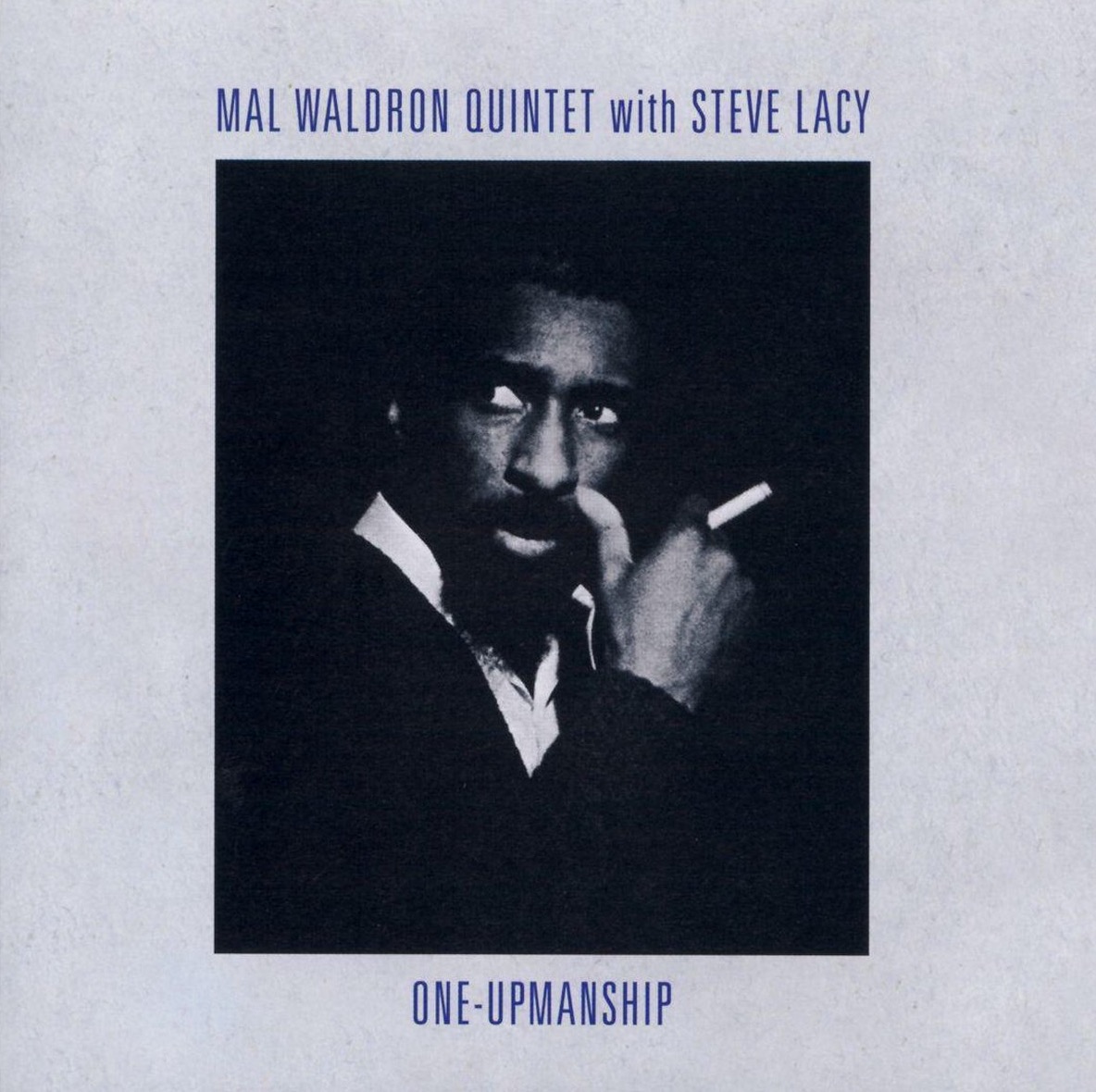
(1977) One-Upmanship *****
With: Steve Lacy (soprano saxophone), Manfred Schoof (trumpet), Mal Waldron (piano), Jimmy Woode (bass), Makaya Ntshoko (drums)
Record date: February 12, 1977
One-Upmanship was the first pre 1963 Mal Waldron album I heard and I fell in love with it immediately. It was the period that, as a listener, I was broadening my horizons trying out some free jazz records. I knew Lacy for it, Mal was still not very well known to me. I was stunned: I never heard a pianist play like this. But also the compositions: I never heard anything like them. They were loud, dark and catchy. Almost funky at places but not the funkiness you wan’t to dance to. I just wanted to sit down and listen. I still regard it as one of my all time favorite jazz albums.
The opening title song sets the tone for the rest of the album: it’s a typical Waldron composition and starts with a catchy theme after which the band slowly fades away and a huge space is created for Lacy’s solo. Lacy is playing a bit more inside than on the America or Victor release but he still surprises with the most strange sounds coming out of his horn then returning back to chord changes or playing with the blues. After his solo the band comes back again with a bridge and then it’s Schoof’s turn to play. And hell he does play a pretty good solo. The sudden break shows the more emotional and calm side of Waldron playing nothing but beautiful notes.
Following up is another Waldron classic, recorded here for the first time. It’s one of Mal’s key compositions, also one of the warm and calm ones. The music has been in my head since I heard it for the first time. The theme hints a bit of classical music but is mostly a very clear description of the Norwegian town of Kristiansund on a cold autumn day. Such atmospheric music. Lacy’s first to solo and as much as he can play beyond the boundaries of jazz he could also play the most beautiful breathtaking notes within those same boundaries. He could play in the highest registers of the instrument and still make it sound beautiful. And there’s also a kind of distance and coldness in his play which funny enough makes it even more beautiful. Mal’s solo is one of simplicity, but he doesn’t play one wrong note. He gently follow’s the changes like the seagulls float in the salty sea air.
The final composition is another Waldron classic: Hurray for Herbie. Not in it’s first appearance on record but it was a studio first time. It starts of with it’s recognizable almost majestic theme. Mal plays a very intense and repetitive solo. As he mentioned himself: “I’ll take two or three notes and really try to milk them dry before I move on to the next two or three notes”. And Mal is a perfect example of all the possible fascinating combinations that are possible with only three or four notes. It makes him the unique pianist he is in jazz, quite the opposite of such a lot of other pianists in those times.
One-Upmanship is one Mal’s better known recordings so it’s not very hard to obtain a copy. If you buy the vinyl version you got the three tracks described above. If you buy the 1998 cd version you get three bonus tracks that were also on the original “Moods” LP. They were from a different session and I will review them with that album. You should get this CD issue especially if you do not own the original Moods LP as 2 of them do not appear on the Moods cd reissue. And those tracks are definitely worth it. One of my first Mal Waldron ‘loves’ and probably one of his best studio albums with one of his strongest groups, One-Upmanship is a must have. Not only for a Mal Waldron fan, but for every jazz aficionado. This is truly essential ’70’s jazz.
Monday, January 25, 2021
(1974) Hard Talk ****1/2
With: Manfred Schoof (trumpet), Steve Lacy (soprano saxophone), Mal Waldron (piano), Isla Eckinger (bass), Allen Blairman (drums)
Record date: May 4. 1974
From the funky and groovy music back to some of the more challenging jazz! On the 4th of May, Mal performed at the Jazz Ost-West Festival with nothing less than a supergroup. Most of the guys already performed before with Mal on record, everyone except the talented German trumpeter Manfred Schoof. Schoof, a musician who was active in the German free jazz and avant-garde scene of those days is a perfect match for Mal’s challenging yet structured music.
Filled with four classic Waldron compositions, of which some make a first appearance, this album is breathtaking from the beginning to the end. Really breathtaking as there are no breaks to take a good breathe. Okay maybe on the ‘Russian Melody’. Part from that one: all of the compositions are heavy, dark and very intense. Starting with the classic ‘Snake Out’ the tone is set for the rest of the album. Schoof kicks off with a great solo: though he’s definitely an advanced and free player his playing sounds at ease and accessible. It’s a lust for the ears to be honest as he not tries to blow them up but actually say something meaningful trough his horn. Then there’s Lacy who really has a more avant-garde feel in his playing. But Lacy always make sense, even when he climbs in the highest registers of his instrument. The title song ‘Hard Talk’ runs for almost 20 minutes but definitely manages to keep the listener’s attention. The theme is very interesting both rhythmically as melodically. Trough the whole music there are multiple breaks and more silent parts where there is intimate background playing to give Lacy all the space he needs. There’s even more silence when almost the whole band fades out for Mal’s amazing classic oriented solo. Again it’s the use of silence which makes it even more beautiful. Than from that solo, as both Eckinger and Blairman join again, Mal works towards it’s climax with one of best solo’s ever captured on record.
‘Russian Melody’ is beautiful moment to take some rest. It’s a calm and relaxed ballad with some beautiful playing by all of the musicians. On this composition it’s Mal and Isla Eckinger that steal the show. When Mal solos, Isla starts conversing with him. He’s one of the most underrated bassist I know and always surprises me with his sensitivity to others and what they are doing. If you’ve got this on vinyl, your journey ends here. That is too bad because you’ll miss one of the classic Mal Waldron compositions recorded for the first time here: ‘Hurray for Herbie’, written in honor of the great and underrated pianist Herbie Nichols. It’s not the best version Mal ever recorded but it is good… Very good!
So the cd version is definitely worth checking out for that extra track. I have got the 2013 ‘Enja Classics’ edition which I really dislike for it’s sober packaging and misprint on the side of the digipack which says: ‘Black Glory’. How the hell could someone make such a mistake and still put it out for sale? Then there’s no liner notes, no photographs and no original artwork. I never understand why labels, in the decade of steaming and downloads, do not do their best to create an appealing product. I mean really, the only reason why one would still buy a cd is the packaging right? Please convince me to buy your product….. But in the end it's all about the music of course. And this is some very, very good music! Highly recommended!
Tuesday, January 12, 2021
(1971) Sonny Grey / Alain Hatot / Mal Waldron / Gus Nemeth / Kenny Clarke - Skippin' ****
Record date: November 3,1971
Mal never fails to surprise. Skippin’ is such a different recording than his other records in 1971. With this solid group he goes back into bop territory. Pretty advanced bop, but definitely bop. And in this more traditional setting he still sounds great and very much at ease. Yet in his own compositions the music is more free again and the rest of the band handle that surprisingly well.
This release was originally under Sonny Grey’s name. Grey, a Jamaican by nationality, is a pretty obscure trumpeter not found on many records. He resided in Paris and recorded with Daniel Humair, Kenny Clarke and made a side appearance next to Dexter Gordon and George Arvanitas. He’s heavily involved in the more traditional hardtop sound, with a huge influence from Clifford Brown. Yet he’s definitely original enough to sound interesting. Tenorist Alain Hatot never really released a record himself but made hundreds of appearances with other musicians. Gus Nemeth is also a more obscure name and Kenny Clarke…. well I assume everybody knows that giant. Kenny lived in Paris of course so he was probably just a phone call away for this record.
Most of the guys really manage to surprise. In the more traditional bop composition Skippin’ (by Grey) all the guys seem to be very much at ease with the repertoire. Grey sounds excellent, playing a nice solo though his trumpet sounds a bit… broke or something. Like the sound is not fully clear. Hatot sounds great also but doesn’t sound very original in this setting. He sounds like a Dexter Gordon imitator. Clarke is Clarke, he just plays tight as a m*therf….. He has played this kind of stuff tons of time and never misses a beat.
The whole thing gets more interesting on Mal’s own composition ‘Journey Without End’, which would be recorded later that year with Steve Lacy in a much more free setting. But the version here is no bop either. This is moving into more free territory and the whole band anticipates greatly on it! Grey has clearly listened to the more free players of those day like Don Cherry but also Woody Shaw. But it’s Alain Hatot who surprises me the most. He really has something to say here. He sounds inspired and original. He dares to step out a bit but does not lose himself in playing random notes or trying to imitate a free jazz saxophonist. Great stuff. And also Nemeth and Kenny Clarke, who is a more bop oriented player, really sound like they know what they are doing. Kenny has recorded more of course with free players, like Noah Howard.
On side B that kind of stuff is continued in another Mal Waldron composition: ‘The Fire is Now’ which is a very restless composition with lots of energy. Kenny Clarke drives up the band with his constant riffs and roles on the snare drum. The final composition is more conventional and in the bop style. Not bad but still the most boring on this record.
The original Numera LP is a collector’s item. It is not sold for less than 200 dollars. I personally never care for what version I have, cd or LP as long as the sound quality is good and I love a big booklet with good liner notes. An original pressing is less important to me. I’ve got the 1974 Japanese release on Mercury of this record with different cover art and Mal stated as leader (probably because his name would sell more in Japan). It sounds absolutely great and is available for something between 20 and 30 euros. A more than reasonable price for a great recording. Mal’s part is not that of a leader but he gets solo space on every song.