Showing posts with label Enja. Show all posts

Saturday, May 8, 2021

(1987) Marty Cook Group - Red, White, Black & Blue ***


With: Marty Cook (trombone), Jim Pepper (tenor & soprano saxophone), Mal Waldron (piano), Ed Schuller (bass), John Betsch (drums)
Record date: November 23 & 24, 1987

Marty Cook is an American trombone player who is a little underrecorded. In the 1970's he appeared mostly in freejazz or avant-garde settings with the likes of Marzette Watts, Jeanne Lee and Gunther Hampel. He moved to Munich in 1979 and that is probably how he met Mal. He formed his 'New York Sound Explosion' band there that also consisted of players like John Betsch and Jim Pepper. The whole quintet playing here knew each other from several occasions and most of them were to play on more records together. Mal recorded with Pepper before that very same year and the excellent rhythm section present here would appear on quite a few albums by Waldron. Mal does not appear on all of the tracks but only on 'Spirit War', 'Love Life', 'Grab Bag' and 'Trapeze'. 

Not a lot of avant-garde or free music to be found here. It's all a pretty big step from the New York Loft sounds of the 1970's where Cook also participated in. The music is structured and mostly in the modern bop tradition. The few outbursts by Pepper's tenor aren't very shocking. Though is group definitely has it's moments it fails to make up to it's potential. Most of the musicians sound a little uninspired. Marty Cook improvises in a very monotone and predictable way without any interesting turns or twists. Pepper sounds like he did not had his day. I miss the powerful almost paranoid like playing from his later recordings with Mal. He mostly draws between the lines perfectly but his capable of more than that. Mal is on 4 tracks but his solo space is very limited. The first place to show off a little is on the 3rd track where he is present. He mostly sounds a little restrained but does give a glimpse of the stuff that to come with the rhytm section. 

So what's there to say in a positive way about the recording? Mosty of the compositions are pretty catchy. Stuff like Spirit War, Mr. DC and Trapeze sound excellent and make a lasting impression. It's a pity that they were only played on this session, for as far as I know. Also none of the guys plays bad. It's clear that every single one of them knows what he is doing and the technical skills and licks are all great. And finally: the rhythm section. Schuller and Betsch together works like magic, hand in glove. They complement each other rhythmically and their playing here definitely lifts the music to a higher level. 

A pretty much ok recording but far from essential. If you want the complete session you'd best get the CD version on Enja or TUTU. Plenty of copies to be found. 

Wednesday, April 28, 2021

(1966) Dusko Goykovich - Swinging Macedonia ***1/2


With: Dusko Goykovich (trumpet, flugelhorn), Nathan Davis (flute, soprano saxophone, tenor saxophone), Eddie Busnello (alto saxophone), Mal Waldron (piano), Peter Trunk (bass), Cees See (drums)
Record date: August 30 & 31, 1966


1966 was the year of Mal’s slow comeback to the jazz scéne in Europe. He recorded his first two albums as a leader, both in Italy before moving to Germany. In Germany he first lived in the city of Cologne before eventually settling in Munich for more than 20 years. In Cologne, Mal lived near the Yugoslavian trumpeter Dusko Goykovich and he gigged regularly with him. Goykovich was born in the town of Jajce which is located in current Bosnia Herzegovina. Those were the years of Tito, communism, the iron curtain and Yugoslavia’s no affiliation politics. There might have been a big barrier in Europe in those years but jazz really is an international language and there was a lively jazz scene in Yugoslavia.

For this album Dusko is not only accompanied by Waldron but also by the excellent and highly underrated multi reedist Nathan Davis (I love that guy). The other guys were all well established names in the European jazz scene all appearing on countless of European jazz cd’s. Peter Trunk was in Hans Koller’s band for a while and Cees See appeared more than once next to Waldron. They are all very solid players, although I find Busnello a little boring.

This is some very interesting music for the period it was recorded in, the combination of names in personnel but also the repertoire played. The Eastern European influence in pretty evident in some of the compositions and there’s a slight hint of some fine gipsy jazz here and there. The results are sometimes pretty successful. The opening Macedonia and also the Fertility dance sound exotic, creative and full of power. An excellent blend of different musical cultures. Also Mal’s percussive style fits in perfectly. ‘Saga Se Karame’ truly sounds amazing with a fantastic soprano solo by Davis. This was really some of the more advanced music with plenty of space for both See and Trunk to come out of their comfort zones. But on the more contemporary jazz compositions all the energy fades away and that is very unfortunate. Songs like ‘The Gypsy’ and ‘Old Fisherman’s Daughter’ or ‘Bem-Basha’ miss that creative spark and are really one out of a dozen of jazz records. No bad playing but just not as interesting as those more up tempo compositions with that Eastern feeling.

Dusko really is an excellent player with great technical skills. The influence by Miles is a little to big here and there (especially when he is playing the muted trumpet) but he has enough power to really make a statement. He also had fine compositional skills as most of these originals by him prove. Both Davis and Waldron are in excellent form but sounded better on their own records from those years. They mostly shine on the more original compositions where they have more space to show off their own creative forces. The rhythm section plays excellent but is mostly in the background.

This was originally released on Phillips, Columbia and Odeon. Those originals are worth quite some money. The Enja reissues are a better buying option. This record really has two faces: the compositions where the Eastern influences are more dominant are very interesting. The more contemporary jazz compositions are a little boring and feel like they are unnecessary breaks in mostly creative music.


Tuesday, April 27, 2021

(2002) Archie Shepp & Mal Waldron - Left Alone Revisited *****


With: Archie Shepp (tenor saxophone, soprano saxophone, vocals), Mal Waldron (piano)
Record date: February 9 & 10, 2002


So there it is then: Mal’s last record. Still in Paris he teamed up with legendary saxophonist Archie Shepp for 9 songs that were all more or less affiliated with Lady Day. Mal was Billie’s last pianist and lots of people still remember him that way. He sometimes admitted he was getting a little tired of the endless questions about his time with her. In every interview the first question was always: so how was it working with Billy Holiday? Mal was indeed an excellent last pianist to her and he was also a personal friend (Billie is godmother to his daughter Mala). But as this whole blog proves: Mal has moved on since then and did lots of other interesting things.

Yet Lady Day always remained a special place in his heart. Her death devastated Mal as he always looked up a little bit to her. He saw her a bit as a mother figure and loved working with her. Later he stated that if Bilie would have stayed in Europe in 1958 she would probably still be alive. I do not know about that but he sure had a special bond with her. After her death he regularly revisited compositions he had written with or for her. One of Mal’s key compositions was written with Billie on an airplane. Mal wrote the music, Billie did the lyrics. That composition was ‘Left Alone’ which was also the title of his Bethlehem album with Jackie McLean. And it also gave it’s title to his very last album.

This date really remains one of my all time favorite records by Mal, if not one of my very favorite jazz records. The chemistry with Archie Shepp is immense. He had worked before with Mal, not on official records but on gigs and there are several bootlegs circulating. And of course the recording with Tchangodei which was an official one but is pretty rare. Shepp’s raw and bluesy lyricism fits so incredibly well with Mal’s deep emotional statements on the piano. It’s like they activate the most lyrical part in each other and this whole music breaths nothing more than pure feeling.

There are the playful almost humorous phrases on standards like ‘Nice Work If You Can Get It’ or the vocal part on ‘Blues for 52nd Street’. Shepp is of course no nightingale but his raw bluesy voice suits excellent here and sounds full of joy and feeling. There are the more laidback statements on ‘Easy Living’ and ‘When Your Lover Has Gone’ that shine from pure excitement and joy. Shepp’s playing is very, very bluesy. Almost in a dirty kinda way. His tone is thick, raw and warm all at the same time. And Mal’s playing is at ease but oh so thoughtful. He carefully weigh each notes and then just let them flow out of his hands. But really the highlight of the album and also of Mal’s career is the most beautiful version of his composition ‘Left Alone’ that was ever put on record. Shepp’s solo goes right trough your bones and hit you in the heart. The sound by this duo here has such a sad feeling, but is is one of absolute beauty, Mal’s solo strikes me the most. It has this very definitive sound, like he knew this would be one of his last statements on record. And also like he is at peace with the life he has lead. Some kind of last statement. It still gives me goose bumps.

Mal had recorded quite a lot of records for Enja but it had been quite a while since he last recorded directly for that label. Yet he remained always affiliated with it trough TUTU records of course. This record is widely avaible for low prices. It’s essential and definitive Mal. It’s also essential Shepp. These are some very great last words by this remarkable pianist.

Where's the love that's made to fill my heart
Where's the one from whom I'll never part
First they hurt me, then desert me
I'm left alone, all alone

Where's the house that I can call my home
Where's the place from which I'll never roam
Town or city, It's a pity
I'm left alone, all alone

Seek and find they always say
But up till now it's not that way
Maybe fate has let her pass me by
Or perhaps we'll meet before I die
Hearts will open, but until then
I'm left alone, all alone

Saturday, February 6, 2021

(1981) What It Is ****1/2


With: Clifford Jordan (tenor saxophone), Mal Waldron (piano), Cecil McBee (bass) Dannie Richmond (drums)
Record date: November 15, 1981


A few days after the Monk tribute concert, Mal went into the Vanguard Studios in NYC to record hist last album for Enja. Well, his last until the 2001 duet with Archie Shepp 30 years later. For “What it Is’ he teamed up with some of the very best jazz artists from the American jazz scene. The great Clifford Jordan on tenor saxophone, the amazing Cecil McBee on bass and the very solid Dannie Richmond on drums.

The album consists of three compositions, 1 by Clifford Jordan and 2 by Mal Waldron. The starting ‘Charlie Parker’s Last Supper’ is probably the most straight-forward. It’s a nice blues and sounds mostly like a warming up for the rest of the album. The following ‘Hymn From the Inferno’ is much more free. It starts with Mal setting up the theme then the band joins him. On this song one could hear Clifford Jordan playing more beyond the boundaries of contemporary jazz than he usually does. Of course he was no conventional bop player anymore since making fantastic albums like ‘In The World’ and ‘Glass Bead Games’. But here he really goes wild hitting of scale after scale and even overblowing his horn. Richmond, Waldron and McBee are also really putting him in that direction. And it doesn’t feel uncomfortable at all, it all goes quite naturally. There’s also some space for one of my favorite bassists of all time: Cecil McBee. His free yet so structured playing is a perfect base for Waldron to play on. Mal Waldron’s solo is again something completely different. Instead of repetition his solo is more focused on hard clusters of sound reacting on Richmond’s awesome playing.

The closing title tune is probably the best of them all. The composition itself is very, very catchy and it it became somewhat of a Waldron standard. It had already been recorded by German drummer Klaus Weiss with a superb group including Billy Harper and Cecil Bridgewater. After Jordan playing that very badass melody in comes Mal with a stunning solo. As always he does not need a lot of notes but the ones he is using are all making sense. But it’s also very much McBee and Richmond that really make the solo for what it is. McBee is going off every single register of his instrument, really heading everywhere without losing Mal for a second. Richmond is just playing to what McBee and Waldron are doing and becomes a full part of the music instead of just someone creating a beat or rhythm. His extensive use of the bass drum really pushes the music forward. He really is one beast at the drumming kit. Not very strange he fits in so well with Mal as Don Pullen who he played with so often is also a very percussive player. His solo’s on this album really want to make you jump out of your chair and yell and cheer. The incredible interplay between the three creates climax after climax. Then finally there is one treat left: a superb solo by Jordan with his bluesy tone and awesome technique. He is a very exciting saxophonist without getting too freaky. And he clearly feels what Mal is trying to say adding up to the dark atmosphere of the composition. It’s nice to hear him getting a little outside his own comfort zone.

There are several versions available on vinyl on the web. Only one cd version was released by Enja Germany that mistakenly notes that the title song only lasts for 5 minutes. Fortunately it is almost 20 minutes! Mine was signed by Mal. Unfortunately I never met Mal nor seen him live (I was 11 when he died), it’s how I bought it. And I am pretty sure it’s really his signature as I do not see a reason to falsify it. This is one of the standout Mal records that should be in every jazz collection. The only reason for me that it doesn’t get 5 stars is the opener which is ok, but doesn’t have the same level as the two Waldron compositions. This really should have been Mal’s touring band for a while. Their interplay is like magic.

Friday, January 29, 2021

(1979) Mingus Lives ***


With: Mal Waldron (piano solo)
Record date: February 29, 1979


In 1979 Mal was on tour with German drummer Klaus Weiss. Having released two masterpieces in the previous years he wasn’t really active in 1979 in the studios. The only record he really made was this solo live record, which was recorded in a small jazz club in Spa, Belgium. He plays originals only of which two are pretty well known: Snake Out and Here, There and Anywhere (which is mistitled and should have been Here, There and Everywhere). 

This really isn't one of his most recommendable solo works to be honest. Though there are some pretty good and interesting parts, most of this solo effort is a bit forgettable. The opening title tune misses a bit of a direction but it misses mostly that typical Mal feeling. It’s a nice effort but it’s just nothing special. One would have expected more from Mal honoring the great bassist. The version of ‘Snake Out’ is the most interesting on this album. Mal takes his time to fully stretch out on it and plays like a maniac almost destroying the pianos keys. Much energy for just a solo performance. As he speeds up he never gets out of time or off beat anywhere. A prime example of his percussive playing. The other interesting part comes with ‘Here, There and Everywhere’ which again is sped up a little and full of passion.

What is really bothering is that the piano is out of tune. In some parts it’s acceptable but in other parts it really ruins Mal’s playing. Keith Jarrett probably would have become very angry and left the concert venue. Fortunately Mal is a more modest person and did play the damn thing but one can’t make right what sounds wrong of course.

‘Mingus Lives’ was never released on cd, probably because of what I am writing in my review: it’s not a bad record at all but there are far more interesting solo sessions by Mal, both live as in the studio. It's widely available for a low price on the web. Nice to have but not essential.

(Correction: Mingus Lives now has a first time cd release! Reissue on Solid records)

(1978) Moods ****1/2


With: Terumasa Hino (trumpet), Hermann Breuer (trombone), Steve Lacy (soprano saxophone), Mal Waldron (piano), Cameron Brown (bass), Makaya Ntshoko (drums)
Record date: May 6 and 8, 1978


One-Upmanship’s follow up album one year later was named Moods. It’s almost equally as great, almost…. The personnel is a true reflection of our worlds inhabitants, a United Nations in jazz with Hino from Japan, Breuer from Germany, Lacy, Waldron and Brown from the U.S.A and Ntshoko from South Africa. That diversity gives the music an extra dimension. Moods is partly filled with solo sessions, and three sextet performances. There are a few well known Mal compositions like ‘Sieg Haile’, 'A Case of Plus 4s' and the first appearance of 'Soul Eyes' by Mal as a leader.

The group parts are probably the biggest highlight of the album. It’s a killer group with experienced musicians. ‘Sieg Haile’ has always been a fantastic piece of music, in any form. But with a group like this it’s coming close to perfection. That perfection starts with Brown’s groovy bass and Ntshoko multirythmic cymbal playing and a thick bass drum that sets the beat. Lacy plays a pretty subdued solo (at least for his doing) showing some of the skills he would use in later duets with Mal. Hino’s a pretty loud player too but his solo here is thoughtful and explorative in a pretty gentle manner. He really tries to focus his playing on the rhythms provided by the rhythm section. Mal’s solo is one of great ease and a very bluesy feel. It’s just feeling, no more and no less. And just like Hino Mal’s talking to the rhythm section constantly and they react at what he’s doing.

Minoat has a bit of a Mingus feel. And Mal was definitely inspired by the great bassist, playing with him on several of his albums including the classic ‘Pithecanthropus Erectus’. It could be the score of a movie also, reminding a bit of his Impulse! from 1967 ‘Sweet Love, Tender’. Terumasa plays a very soulful solo with lot’s of extra air trough his horn. But his tone always remain powerful and very confident. Minoat is probably one of Waldron’s most accessible works from this time. The last sextet song is ‘A Case of Plus 4’s’ which is a more brooding Mal composition appearing here for the first time. In it’s second appearance it would be a duo with Lacy and be a bit more laidback. The music here is intense with Hino playing the lungs out of his body. He plays small runs of multiple notes, then returning to loud one or two note statements interacting with both Mal and Ntshoko. Lacy plays another great, relatively inside solo. Only Breuer fails to really impress me. The one who actually steals the show is Mal himself milking those same notes again. Mal is bluesy, funky and swinging all at once. And Cameron Brown is also in prime form following the funky lines from Mal’s piano. Brown had already proven himself to be a great bass player with Archie Shepp and he really fits in this group. Great solo by him too.

The solo parts are sometimes beautiful, and sometimes just okay. Anxiety is a Waldron composition which truly reflects what it’s title stands for. It’s an interesting listen yet fails to really catch me like so many other Mal compositions did. ‘Thoughtful’ is tearjerking beautiful with it’s sad feeling all trough the piece. Amazing to hear how Mal’s left and right interact with each other. The same goes for ‘Lonely’ where Mal could say a thousand things with the spare notes he uses. Again a song with a deep emotional feel. Beautiful until it slightly merges into a blues than returning to the theme again. The solo sessions are also a nice alternation with the sextet parts. Some kind of break to take a breath. “Happy” is a more up-tempo blues with a repetitive feel. It indeed has more of a happy feeling but like the opening ‘Anxiety’ it fails to stay interesting all trough the song. Absolute solo highlight is of course the beautiful version of Mal’s best known classic ‘Soul Eyes’. Made famous by the great John Coltrane, it’s very refreshing to hear the song coming out the hands of the composer. Mal treat’s his classic with respect and love and stays close to the original theme. He show’s his more classical oriented solo style here with a pretty good technique in both hands playing fluent lines of notes. Fortunately he was to record this composition more than only this time.

As I mentioned before in my ‘One-Upmanship’ review: if you do not have the German cd issue of that session, you should get Moods on vinyl. Otherwise you miss two solo parts: Thoughtful and Duquility. They probably left those two out on the ‘Moods’ cd issue because of the time but it’s really a stupid thing to do. They should have made it a double cd instead and include the full session. I own the 24bit master edition on cd from 2006. It’s great in sound quality but lacks any liner notes which is really another missed opportunity. It’s definitely the cheapest option but not the most recommended. It’s definitely worth to buy the original LP. ‘Moods’ itself is highly recommended and among his best records. Mal was really in prime form this period.

Wednesday, January 27, 2021

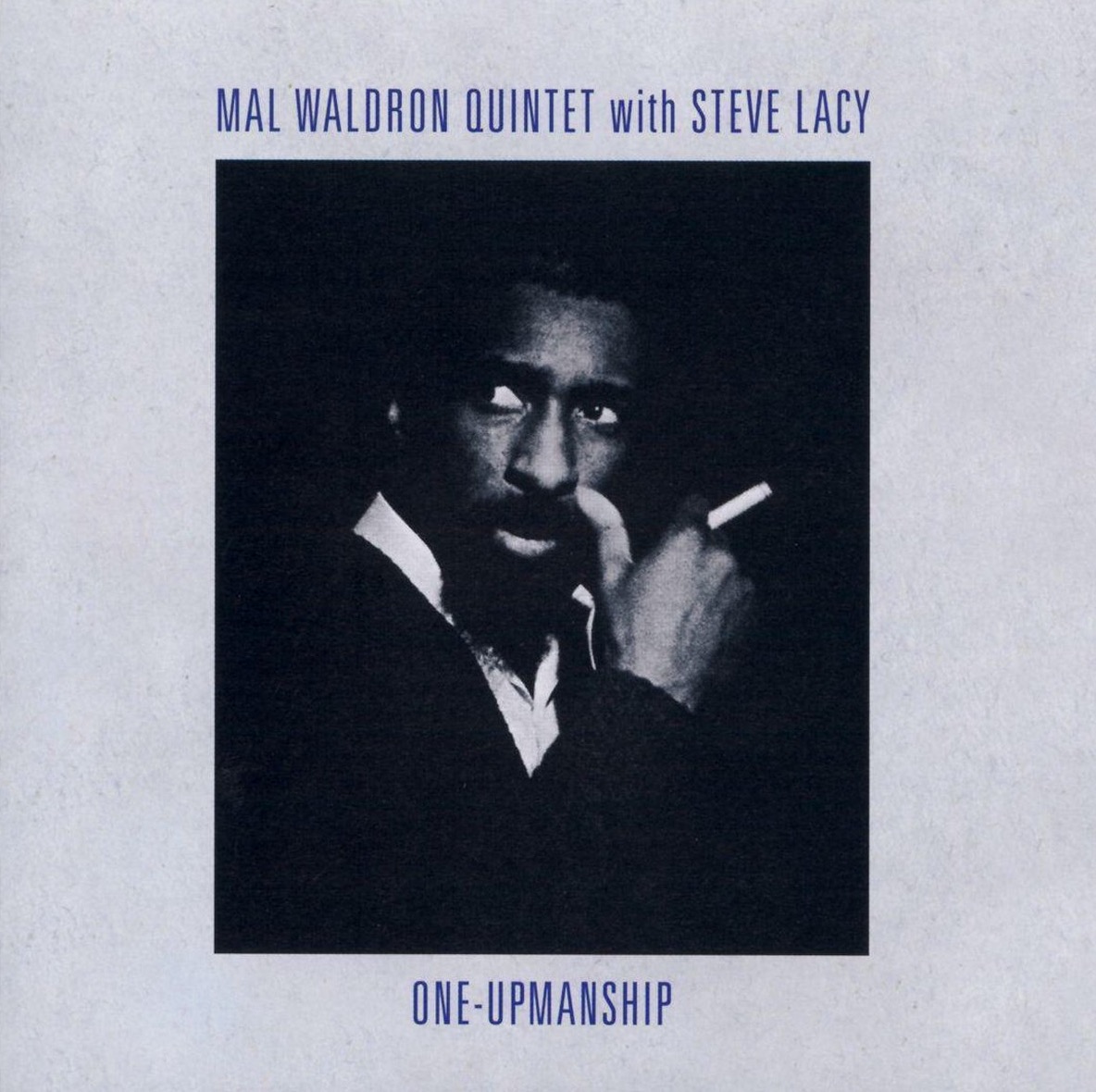
(1977) One-Upmanship *****


With: Steve Lacy (soprano saxophone), Manfred Schoof (trumpet), Mal Waldron (piano), Jimmy Woode (bass), Makaya Ntshoko (drums)
Record date: February 12, 1977


One-Upmanship was the first pre 1963 Mal Waldron album I heard and I fell in love with it immediately. It was the period that, as a listener, I was broadening my horizons trying out some free jazz records. I knew Lacy for it, Mal was still not very well known to me. I was stunned: I never heard a pianist play like this. But also the compositions: I never heard anything like them. They were loud, dark and catchy. Almost funky at places but not the funkiness you wan’t to dance to. I just wanted to sit down and listen. I still regard it as one of my all time favorite jazz albums.

The opening title song sets the tone for the rest of the album: it’s a typical Waldron composition and starts with a catchy theme after which the band slowly fades away and a huge space is created for Lacy’s solo. Lacy is playing a bit more inside than on the America or Victor release but he still surprises with the most strange sounds coming out of his horn then returning back to chord changes or playing with the blues. After his solo the band comes back again with a bridge and then it’s Schoof’s turn to play. And hell he does play a pretty good solo. The sudden break shows the more emotional and calm side of Waldron playing nothing but beautiful notes.

Following up is another Waldron classic, recorded here for the first time. It’s one of Mal’s key compositions, also one of the warm and calm ones. The music has been in my head since I heard it for the first time. The theme hints a bit of classical music but is mostly a very clear description of the Norwegian town of Kristiansund on a cold autumn day. Such atmospheric music. Lacy’s first to solo and as much as he can play beyond the boundaries of jazz he could also play the most beautiful breathtaking notes within those same boundaries. He could play in the highest registers of the instrument and still make it sound beautiful. And there’s also a kind of distance and coldness in his play which funny enough makes it even more beautiful. Mal’s solo is one of simplicity, but he doesn’t play one wrong note. He gently follow’s the changes like the seagulls float in the salty sea air.

The final composition is another Waldron classic: Hurray for Herbie. Not in it’s first appearance on record but it was a studio first time. It starts of with it’s recognizable almost majestic theme. Mal plays a very intense and repetitive solo. As he mentioned himself: “I’ll take two or three notes and really try to milk them dry before I move on to the next two or three notes”. And Mal is a perfect example of all the possible fascinating combinations that are possible with only three or four notes. It makes him the unique pianist he is in jazz, quite the opposite of such a lot of other pianists in those times.

One-Upmanship is one Mal’s better known recordings so it’s not very hard to obtain a copy. If you buy the vinyl version you got the three tracks described above. If you buy the 1998 cd version you get three bonus tracks that were also on the original “Moods” LP. They were from a different session and I will review them with that album. You should get this CD issue especially if you do not own the original Moods LP as 2 of them do not appear on the Moods cd reissue. And those tracks are definitely worth it. One of my first Mal Waldron ‘loves’ and probably one of his best studio albums with one of his strongest groups, One-Upmanship is a must have. Not only for a Mal Waldron fan, but for every jazz aficionado. This is truly essential ’70’s jazz.

Monday, January 25, 2021

(1974) Hard Talk ****1/2


With: Manfred Schoof (trumpet), Steve Lacy (soprano saxophone), Mal Waldron (piano), Isla Eckinger (bass), Allen Blairman (drums)
Record date: May 4. 1974


From the funky and groovy music back to some of the more challenging jazz! On the 4th of May, Mal performed at the Jazz Ost-West Festival with nothing less than a supergroup. Most of the guys already performed before with Mal on record, everyone except the talented German trumpeter Manfred Schoof. Schoof, a musician who was active in the German free jazz and avant-garde scene of those days is a perfect match for Mal’s challenging yet structured music.

Filled with four classic Waldron compositions, of which some make a first appearance, this album is breathtaking from the beginning to the end. Really breathtaking as there are no breaks to take a good breathe. Okay maybe on the ‘Russian Melody’. Part from that one: all of the compositions are heavy, dark and very intense. Starting with the classic ‘Snake Out’ the tone is set for the rest of the album. Schoof kicks off with a great solo: though he’s definitely an advanced and free player his playing sounds at ease and accessible. It’s a lust for the ears to be honest as he not tries to blow them up but actually say something meaningful trough his horn. Then there’s Lacy who really has a more avant-garde feel in his playing. But Lacy always make sense, even when he climbs in the highest registers of his instrument. The title song ‘Hard Talk’ runs for almost 20 minutes but definitely manages to keep the listener’s attention. The theme is very interesting both rhythmically as melodically. Trough the whole music there are multiple breaks and more silent parts where there is intimate background playing to give Lacy all the space he needs. There’s even more silence when almost the whole band fades out for Mal’s amazing classic oriented solo. Again it’s the use of silence which makes it even more beautiful. Than from that solo, as both Eckinger and Blairman join again, Mal works towards it’s climax with one of best solo’s ever captured on record. 

‘Russian Melody’ is beautiful moment to take some rest. It’s a calm and relaxed ballad with some beautiful playing by all of the musicians. On this composition it’s Mal and Isla Eckinger that steal the show. When Mal solos, Isla starts conversing with him. He’s one of the most underrated bassist I know and always surprises me with his sensitivity to others and what they are doing. If you’ve got this on vinyl, your journey ends here. That is too bad because you’ll miss one of the classic Mal Waldron compositions recorded for the first time here: ‘Hurray for Herbie’, written in honor of the great and underrated pianist Herbie Nichols. It’s not the best version Mal ever recorded but it is good… Very good!

So the cd version is definitely worth checking out for that extra track. I have got the 2013 ‘Enja Classics’ edition which I really dislike for it’s sober packaging and misprint on the side of the digipack which says: ‘Black Glory’. How the hell could someone make such a mistake and still put it out for sale? Then there’s no liner notes, no photographs and no original artwork. I never understand why labels, in the decade of steaming and downloads, do not do their best to create an appealing product. I mean really, the only reason why one would still buy a cd is the packaging right? Please convince me to buy your product….. But in the end it's all about the music of course. And this is some very, very good music! Highly recommended!

Saturday, January 23, 2021

(1973) Up Popped The Devil ****


With: Mal Waldron (piano), Reggie Workman (bass), Billy Higgins (drums)
Record date: December 28, 1973


Where 1970, 1971 and 1972 were among Mal’s most productive years, the stream of records faded all of a sudden in 1973. Until 1980 he put out only one record a year, sometimes two but also none at all (at least not as a leader). I don’t know the reason for it but one must say: the stuff he did put out was of very, very high quality.

In December 1973 Mal made his first recording in an American studio since his recording of the score for 'Sweet Love, Bitter'. According to himself he left the country for it’s climate of competition, racism and the presence of drugs in the jazz scene. He once told an interviewer that if he had stayed in 1965, he’d be probably dead in a year. When he went back he recorded with two guys he never recorded with before (but he probably knew them from the early ’60’s jazz scéne. Those guys were Reggie Workman and Billy Higgins. I do not have to say anything to explain that these guys were two heavyweight giants themself playing with practically every big name in jazz in any style. And their playing goes very well with Mal’s playing style.

The album is filled with four typical Mal Waldron compositions. The opening title song is immediately recognizable as to be from Mal’s hand. It’s repetitive walk with his left hand in the lowest registers of the piano and his percussive attack with his right hand. Workman immediately dives in to it with his dark voice on bass, using his bow that really adds up to the grooming atmosphere. Higgins’ is solid as he always is. I never heard him missing a beat. He’s probably one of the most reliable drummers in jazz, able to adapt every style and play his ass off. He’s far from unconfortable with the more free oriented music on this record. The second song is less of a typical Waldron composition. It has Carla Poole on flute and has the feeling of free improvisation. It’s more of a soundscape that is created than a song and they do it in a perfect way. Though it sounds like impro it’s till very accessible and it’s again Workman that really steals the show being so much more than a bassist that just set chords.

The third composition was to become one of Mal’s trademark compositions. It’s the song that this whole blog is named after: ‘Snake Out’. It’s a constantly hunting composition that reaches climax after climax. Both Workman and Higgins swing their tits off with Higgins playing multiple rhythms at once. Mal’s solo is nervous, hard-hitting and swinging. This is the stuff he plays best. The only thing I miss here is Lacy… I am used so much to those versions I almost can’t hear it without Lacy blowing his soprano to pieces. The closing Changachangachanga (that’s a great title) is another Waldron original. Again it’s all about interplay between the musicians with Workman playing beautiful stuff on his bass. After the rhythmic more free theme Higgins set up a beat for Waldron and Workman to improvise on. Another great song.

There are several releases available but non of them is really cheap. The original LP is pretty expensive for a Enja record. I’ve got the 2003 cd but do not recommend it. It doesn’t sound very clear and Higgins is too far up the mix. I cannot speak for other versions. This one was also reissued quite recently in the Solid budget version in Japan. The whole record is easily recommended. It’s a beautiful insight in a very fruitful collaboration to come. With Higgins two more times, Workman would return multiple times at his side forming some sort of first set group by Mal with Eddie Blackwell. Their interplay is always a treat.

Saturday, January 16, 2021

(1972) A Touch of the Blues ****


With: Mal Waldron (piano), Jimmy Woode (bass), Allen Blairman (drums)
Record date: May 6, 1972


In May 1972, Mal was back in his new found homeland: Germany. He appeared in trio form on the Jazz Ost-West festival with someone known and someone less known. The known person here was of course Jimmy Woode who was also on Mal’s side during the legendary sessions at ‘the Domicile’ club in Munich one year before. The less known person is Allen Blairman, an American jazz drummer living in Europe who already made an appearance with Albert Ayler and played with musicians like German vibist Karl Berger. The recording of the appearance at the festival resulted in the release of ‘A Touch of the Blues’ 5 years later on the Enja label.

The concert opens with Here, There and Everywhere which was previously recorded on ‘A Little Bit of Miles’. Apparently Mal always had some kind of set repertoire though on every album, you find new compositions. The version here is more interesting than the one on ‘A Little Bit of Miles’. And that has mostly to do with the sideman. Woode is such an experienced bassist: he sounds so much at ease with these originals by Mal. And despite the modal feel of them he still manages to sound creative and surprising with every single note he plays. During Mal’s solo’s he seems to float on the music itself heading in all directions. Again, the space he gets is pretty big and he manages it just fine. Drummer Blairman is a solid man in the background, not Mal’s most daring drummer, but a solid sideman alltrough. Part from the better musicians, the music heads in more directions also. It swings, it’s bluesy, it waltzes and sometimes freak out a very tiny bit. Finally the composition merges into ‘The Search’, a beautiful composition that also appears on the very mysterious similar titled album that is on Spotify.

Side B is filled with just one lengthy composition: the title song ‘A Touch of the Blues’. Do not expect a boring or predictable blues that just keeps on going for 19 minutes. The theme itself already is changing a few times, and so does the music. It goes anywhere from a warm meandering theme to some hard swinging here and there. Yet it does have that full bluesy feel. Both solos by Woode and Blairman are excellent with Woode hitting the snares of his bass very hard. The way he takes his space in the music reminds me a little of Jimmy Garisson sometimes. The exciting part of the whole composition comes after Woode's solo where the music reaches climax after climax. It's the kind of intensity that makes you sit at the very edge of your chair. Great song, great playing here.

Together with ‘Mingus Lives’ this is one of the lesser known Waldron’s on Enja. That is definitely not making sense as this is a great live session capturing Mal during one of his best periods with a great band. There’s a bunch of vinyl versions mostly from Japan and the original from Germany. Got the original Japanese vinyl version myself which plays perfectly fine. For cd enthusiasts: this was recently released on cd for the first time in Japan on the budget Solid label. The releases I have on that label are perfectly fine. Liners will probably be in Japanese if they exist but there are no liners on the original German release so you do not really miss anything. If you have the possibility to pick this up for a fair price do not hesitate.

Sunday, January 10, 2021

(1971) Black Glory ***** & Mal Waldron Plays The Blues: Live at the Domicile ****1/2


With: Mal Waldron (piano), Jimmy Woode (bass), Pierre Favre (drums)
Record date: June 29, 1971


In June 1971, Mal Waldron appeared with his trio at ‘The Domicile’: a famous jazz clubs in Mal’s then hometown Munich, West Germany. It resulted in two fantastic records: ‘Mal Waldron Plays the Blues’ and ‘Black Glory’. Both were recorded that same night so that must have been a hell of concert!

In these years, Mal did work with a (very large) circle of musicians but didn’t had a regular group as he had later with Reggie Workman and Ed Blackwell for example. So on every ’70’s session it’s a surprise with whom he works that time. Here it’s the great Jimmy Woode on bass and the Swiss drummer Pierre Favre. Woode has played with so many musicians, starting with the Duke, Johnny Hodges and Sidney Bechet, then Johnny Griffin and after that so many more like Ted Curson and Art Farmer. His first recording with Mal was with Benny Bailey at the very same Domicile jazz club. He was to appear on two more records by Mal: the live album ‘A Touch of the Blues’ and Mal’s classic ‘One-Upmanship’. A bassist that was mostly in the background, that on these records really is more up in the mix and gets plenty of solo space to stretch out. He reveals himself to be an amazing bassist with enormous potential. He should have been featured more on other records. Drummer Favre was a much in demand drummer within the European jazz and avant-garde scene playing with the likes of Albert Mangelsdorff, Michel Portal and Iréne Schweizer. But also with Americans like the great Joe McPhee.

Funny to mention: ‘Black Glory’ wasn’t intended to be released in the first place. The plan was to record some of the blues pieces that eventually were on the Japanese Polydor release ‘Mal Waldron Plays the Blues’. The songs on ‘Black Glory’ were to uhm… warm up a little. Enja engineer Horst Weber did a great job recording the complete gig, as ‘Black Glory’ turnt out to be an even stronger record than the other release (though that one is very good also). Black Glory was Mal’s first record for Enja records. The first label he produced multiple albums for part from Victor Japan. Lots of beautiful stuff was to be brought out on the German label: ‘Moods’, ‘One-Upmanship’, ‘Hard Talk’ and even more. It was a fruitful relation.

Black Glory starts of with the Haile Selassie ode: ‘Sieg Haile’. I always wondered if the title wouldn’t be a little controversial in Germany in 1971. After all, the nazi’s were only gone for 26 years. The Bierkeller Putsch there in Munchen was only 48 years ago. Still the title really covers the music: it has a very strong and proud feeling which was probably meant for Selassie but also has that military march feeling. It’s one of Mal’s classic compositions with a fascinating theme. The interaction between Mal and Jimmy Woode is mind blowing. The way Jimmy dances around the chords reminds me of how Scott LaFaro did that with Evans, though this music is completely different. The followup ‘La Gloire Du Noire’ makes a first and last appearance here. It again shows Mal was involved (in his mind at least) with the Black consciousness movement overseas in the United States. ‘The Call’ is of course fascinating to hear in an acoustic version. Horst Weber states he likes the acoustic version better, but for me it’s to close to call. Because of the acoustic sound it does have a more emotional feel. It’s a great song anyway and this version is at least just as good as the electric original on the JAPO album.

For such a classic in someone’s discography, one may state the album is too hard to find. But although long out of print, it is not to difficult to obtain a copy. The whole concert was pretty well recorded. I’ve got the German 1994 release and the Japanese 2006 release. Both are great. This is essential Mal.


With: Mal Waldron (piano), Jimmy Woode (bass), Pierre Favre (drums)
Record date: June 29, 1971 


As this music comes from the very same session as ‘Black Glory’ this review won’t be very long as most of the statements I made there are also speaking for this record. This is the record that was initially meant for release. It’s a big bluesy suite of 5 songs and the tone set on ‘Black Glory’ is very much continued. It’s bluesy, it’s raw, it’s dark and it’s smokey. The space every musician gets is enormous and they all play their butt’s off. Mal said he never really wanted to tell a rhythm section what to play and what not to play. According to them, they had too play what however they wanted to play. That really pays of in live sessions with highly talented guys like Jimmy Woode and Pierre Favre like this. The way Woode imitates motives by Mal and how they interact with each other on “Way in’ for example is just awesome. Don’t think that blues means calm and predictable music here. And though ‘Black Glory’ probably a very tiny bit better, this record still is essential and should not be omitted by any Mal fan.  

The record was initially released in Japan only by Polydor. It was reissued on vinyl in Germany first in 1986 and made it’s first cd appearance in Japan in 1990. I’ve got the German 2001 cd version which doesn’t only sound great but also contains long and informative liner notes including lots of quotes by Mal Waldron. It also was recently reissued in Japan again in a limited budget version on Solid records. Those reissues are mostly pretty cheap and okay sound wise. But do not expect too much from the packaging or liner notes (when you do not speak Japanese of course).